
An ERC Starting Grant is PI-led research, but it is large enough to establish a real research group.
That distinction matters.
The team should not look like a collection of people attached to separate mini-projects. It should look like one scientific programme in which the PI owns the intellectual direction and the team provides the depth, continuity and specialist capability needed to answer the central question.
The ERC allows the PI to employ researchers of any nationality as team members, including team members located outside Europe where scientifically justified. The PI remains responsible for leading the project.
Official source: ERC Starting Grant - Host Institution and Team
Design the team after the scientific architecture
Do not begin with headcount.
Begin with the programme.
Ask:
- Which objectives require sustained experimental or theoretical ownership?
- Which capabilities need senior scientific judgement from the beginning?
- Which tasks are suitable for doctoral training?
- Where does the project need continuity across work packages?
- Which expertise is essential but not sensible to build internally?
- Which parts require the PI's direct attention?
Only then convert the programme into roles.
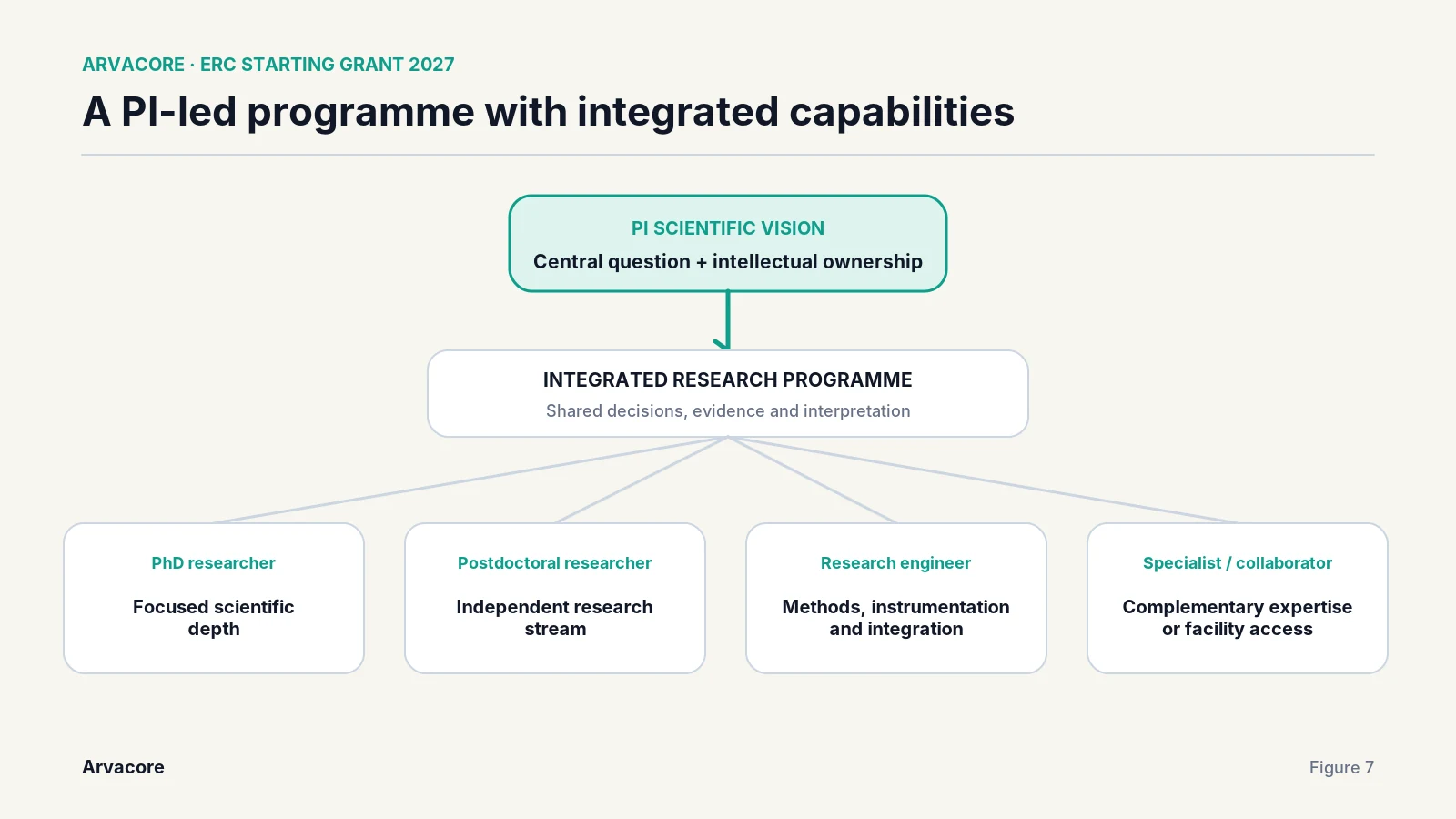
The PI should own the scientific direction while PhD researchers, postdocs and specialists contribute to one integrated programme rather than parallel disconnected projects.
A practical Starting Grant team can be substantial
Depending on country, salary levels, equipment needs and field, a Starting Grant can support a structure such as two or three PhD researchers and one or two postdocs.
That is not a rule or an ERC recommendation. It is a useful planning model for thinking about whether the project is really building a five-year research programme.
The right number may be much smaller or larger depending on the science.
The point is to think beyond "one PI plus one assistant" when the research question requires a broader group.
Use postdocs strategically
Postdocs can provide scientific continuity and reduce the amount of direct day-to-day training the PI must personally absorb.
This can be particularly valuable when:
- the programme contains technically difficult experiments from year one;
- two work streams need to run in parallel;
- the PI is establishing a new laboratory;
- PhD researchers will need substantial supervision;
- a senior researcher needs to integrate data across several objectives;
- the programme requires a method that the PI understands but does not want to spend two years implementing personally.
A postdoc should have a scientific role, not merely act as project support.
PhD roles should map to meaningful scientific questions
Doctoral researchers work best when each thesis has a coherent scientific identity inside the ERC programme.
For example:
PhD 1: establish the new experimental platform and resolve Objective 1.
PhD 2: test the mechanism across a second regime and establish the boundary conditions.
PhD 3: extend the framework to a new class of systems.
The projects should connect strongly enough that the group produces a shared answer rather than three unrelated dissertations.
Collaborators should fill genuine expertise gaps
ERC projects can involve collaborators and team members elsewhere. Collaboration is useful when it adds something the group should not recreate internally.
Examples include:
- specialist fabrication;
- access to a unique facility;
- clinical or field access;
- a theoretical technique outside the group's core competence;
- a rare dataset;
- a complementary measurement.
The proposal should explain why the collaboration strengthens the PI's programme without transferring intellectual ownership away from the PI.
The ERC grant is not a consortium grant.
Protect the PI's intellectual role
The reviewer should be able to answer:
What does the PI personally contribute that cannot be replaced by the team?
That may be:
- the central hypothesis;
- the conceptual framework;
- the integration of theory and experiment;
- the new experimental direction;
- the interpretation across objectives;
- the decision architecture of the programme.
If the proposal can be decomposed into work packages each intellectually owned by someone else, the PI role becomes less clear.
Design for supervision capacity
A five-year programme can become operationally heavy.
The PI may be:
- establishing a group;
- recruiting several people;
- supervising PhD students;
- managing equipment procurement;
- handling institutional responsibilities;
- publishing and disseminating results;
- adapting the science as results emerge.
This is another reason to think carefully about seniority mix.
A team made entirely of early-stage PhD researchers may create more direct supervisory load than a group with one or two experienced postdocs who can help maintain scientific continuity.
The optimal mix depends on the field, but the proposal should show that the team design is realistic for the PI's role.
Build the team around scientific dependencies
If Objective 2 cannot begin until Objective 1 is complete, the team may be unnecessarily serial.
Look for opportunities to create productive parallelism:
- theory and experiment develop together;
- one postdoc builds the platform while one PhD develops the first application;
- a second researcher works on an independent validation path;
- analysis tools are developed before the main dataset arrives.
This can reduce programme risk and improve scientific interaction.
Budget should reflect the team logic
Personnel costs vary significantly across countries and institutions, so there is no universal headcount formula.
The proposal should justify roles in scientific terms:
Postdoc A is required from month 1 because Objective 1 depends on an advanced technique that must be operational before two PhD projects can begin.
This is stronger than:
We request one postdoc for five years.
The same applies to doctoral researchers, technicians, engineers and research software specialists.
The team should help establish independence
A Starting Grant can be a major transition from contributing to someone else's research programme to leading your own.
The team architecture should reinforce that transition.
The PI defines the scientific direction. The people recruited around the grant should make that direction executable and help establish a durable research identity.
That is a different objective from simply adding capacity to the PI's former laboratory.
A practical team-design test
Before finalising the budget, ask:
- Does every role map to a scientific need?
- Is there enough seniority to keep the programme moving while PhDs are trained?
- Can important work proceed in parallel?
- Are collaborators filling genuine gaps rather than owning core objectives?
- Is the PI's intellectual role unmistakable?
- Does the staffing plan remain realistic if recruitment takes longer than expected?
- Does this look like a research group capable of sustaining the programme for five years?
A strong team section should show how the scientific vision becomes a functioning group.