
Part II is where an ambitious ERC idea becomes an executable research programme.
For Starting Grants, Part II is limited to seven pages. It is evaluated at Step 2 together with Part I, the CV and Track Record, the budget and the rest of the proposal. The ERC asks applicants to use Part II for the detailed implementation: methodology, work plan, risk assessment and mitigating measures.
That changes the writing task. Part I should establish why the scientific question deserves to be pursued. Part II should show that the programme can generate interpretable evidence even when the preferred hypothesis is uncertain.
Official source: ERC guidance on the proposal structure and evaluation
Part II should answer a different question from Part I
A useful distinction is:
Part I: Why is this an important frontier-research question, and why could the answer change the field?
Part II: How will the programme discriminate between the scientifically relevant possibilities?
The second question is more useful than simply asking whether every experiment will work.
Frontier research often contains genuine scientific uncertainty. The role of Part II is not to remove that uncertainty. It is to show that the research design is rigorous enough to learn from it.
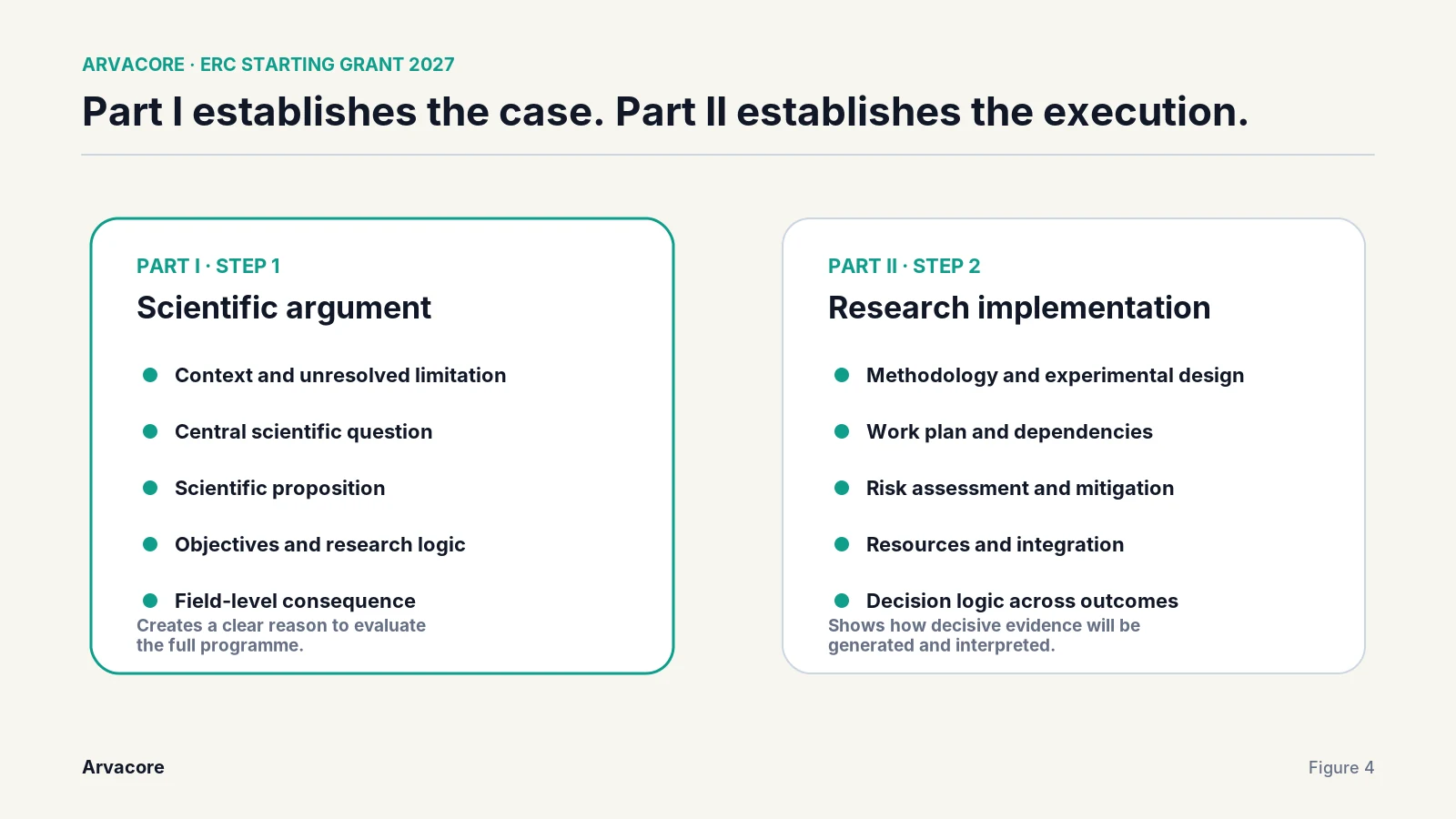
Part I establishes the scientific case. Part II converts that case into a credible research programme with methods, decisions, risk handling and resources.
Start from the scientific decisions
Before writing methods, identify the decisions the programme needs to make.
For each objective, ask:
- What uncertainty is being resolved?
- What evidence would support the preferred explanation?
- What evidence would challenge it?
- What alternative interpretation would then become more plausible?
- Which next experiment, model or analysis follows from each outcome?
This keeps the methodology connected to the scientific question.
A method is valuable because it discriminates between possibilities, not because it is technically sophisticated.
Build the methodology around evidence
A strong methodology section should make clear:
- what will be measured, derived, simulated or observed;
- why that evidence is relevant to the central question;
- what resolution or sensitivity is scientifically necessary;
- what assumptions enter the analysis;
- how competing explanations will be distinguished;
- what controls, baselines or reference systems are required;
- how uncertainty will be quantified;
- how one result changes the next scientific decision.
This is different from writing a protocol.
The reviewer does not need every laboratory action. The reviewer needs confidence that the method is capable of producing an interpretable answer.
Use work packages as a scientific architecture
A work package should have a scientific purpose.
Compare:
WP2: Fabricate and characterise the device.
with:
WP2: Determine whether mechanism X remains dominant below the predicted transition threshold.
The first describes activity. The second describes knowledge to be gained.
A practical structure for each major work package is:
Scientific objective
What uncertainty is being addressed?
Method
What evidence will be generated?
Decision criterion
What result would support or challenge the working hypothesis?
Dependency
What does this enable next?
Alternative route
How does the programme adapt if the preferred route becomes uninformative?
That makes the implementation easier to review and keeps the work plan intellectually coherent.
Separate scientific risk from execution risk
These two forms of uncertainty should be treated differently.
Scientific risk means the answer may not be what you expect.
Examples:
- the proposed mechanism is absent;
- the transition occurs in a different regime;
- two models remain experimentally indistinguishable;
- a theoretical prediction breaks down;
- an assumed causal relationship is incomplete.
Execution risk means the programme may fail to produce interpretable evidence.
Examples:
- fabrication yield is too low;
- recruitment is delayed;
- an instrument cannot reach the required sensitivity;
- access to a facility is interrupted;
- a dataset is unavailable;
- a dependency between work packages becomes critical.
The first category can be scientifically productive. The second needs active management.
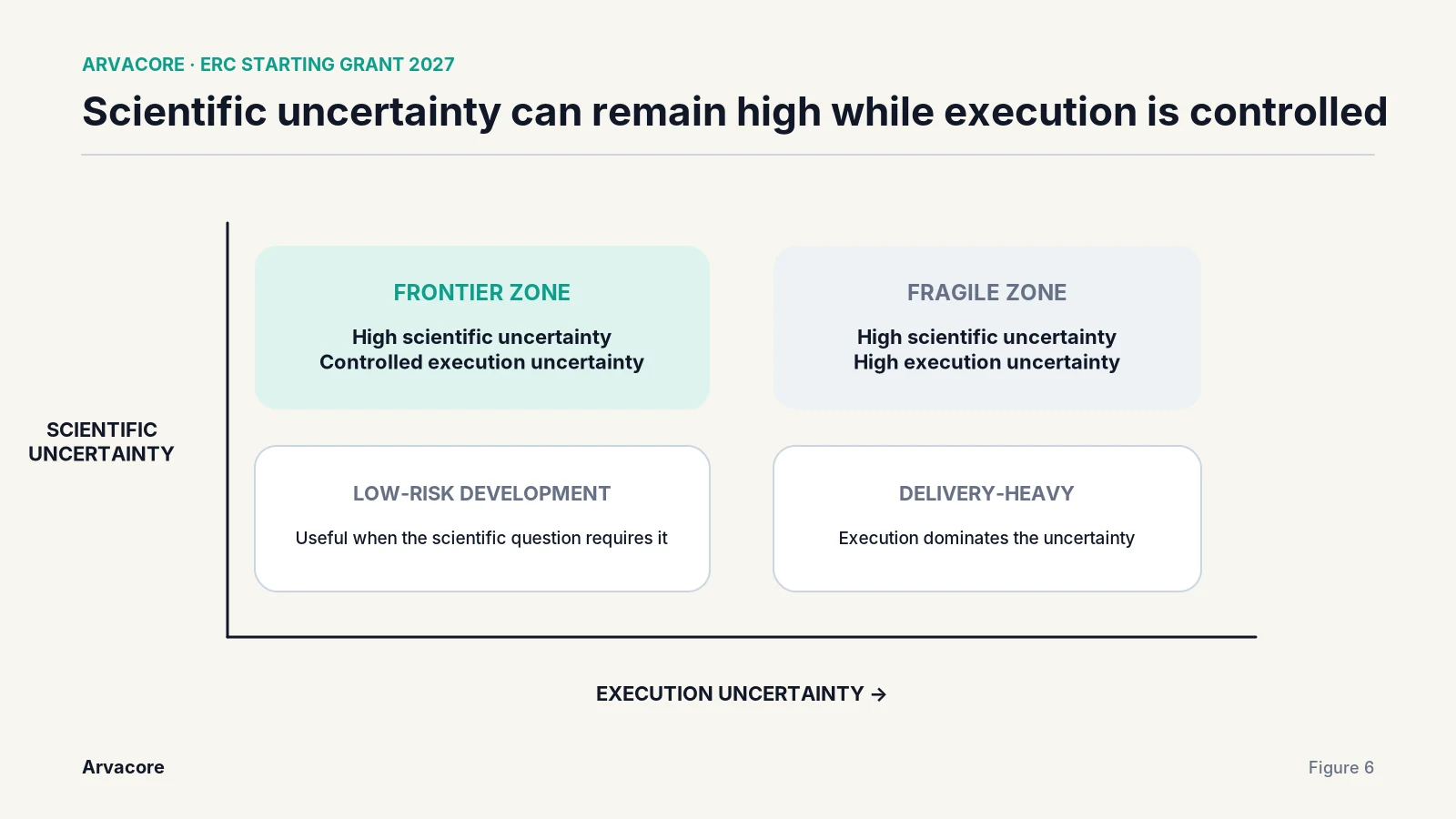
An ERC programme can preserve high scientific uncertainty while reducing avoidable execution uncertainty through design, alternatives and decision points.
Risk mitigation should preserve the scientific question
A weak risk table often reads:
Risk: Method A fails. Mitigation: use Method B.
That may be necessary, but it is not enough.
A stronger approach asks what must remain true for the central scientific question to be answerable.
For example:
- if fabrication route A cannot reach the required regime, route B preserves the relevant physical parameter;
- if direct measurement is too noisy, an indirect observable still discriminates between the two hypotheses;
- if the expected transition is absent, the programme maps the boundary conditions rather than declaring the objective failed.
The alternative should protect the scientific objective, not merely preserve activity.
Show where the programme can change direction
A five-year project should not look rigid.
Useful decision points can be stated explicitly:
Decision point 1: If mechanism A dominates, proceed to test its generality. If not, quantify the competing mechanism and adapt Objective 2.
Decision point 2: If the predicted regime is experimentally accessible, move to direct validation. If not, use the validated model to identify a second observable with equivalent discriminatory power.
This is scientific optionality in operational form.
It demonstrates that uncertainty has been considered before the project begins.
Resources should follow the scientific logic
The budget and resource request are evaluated at Step 2. The ERC expects requested resources to be reasonable and justified.
Do not justify resources as a shopping list.
Connect each major resource to the scientific bottleneck it removes.
Examples:
- a postdoc provides the senior experimental continuity needed to operate two linked work packages;
- a PhD researcher develops the new measurement platform required for Objective 2;
- major equipment provides access to a regime not available at the host institution;
- external facility time is required for the decisive measurement rather than for general characterisation;
- computational resources allow the model to be tested across the parameter range required to distinguish two explanations.
The question is not only "what does this cost?" It is "why does this resource make the frontier-research question addressable?"
Avoid repeating Part I
The ERC explicitly expects Part I and Part II to be complementary.
You can refer back to objectives and concepts already established in Part I. Use the seven pages of Part II for depth that Step 1 did not need:
- experimental design;
- theoretical framework;
- sampling or data strategy;
- validation;
- statistical or computational approach;
- work-package dependencies;
- timeline;
- risk handling;
- resource logic.
Repeating the motivation wastes space that could demonstrate scientific control.
Feasibility should create confidence, not shrink the ambition
One common mistake is to respond to feasibility concerns by making the science smaller.
A better approach is to keep the central question ambitious and make the route to evidence stronger.
This can mean:
- narrowing an experimental regime while preserving the decisive test;
- adding an alternative measurement;
- using staged validation;
- placing the highest-risk experiment after a lower-risk enabling objective;
- assigning experienced personnel to the technically fragile part;
- including an explicit stop/go criterion.
The ambition belongs in the question. Feasibility belongs in the design.
A practical Part II structure
A seven-page Part II can often be organised around the following logic:
1. Research design
Restate the research architecture briefly and define how the objectives interact.
2. Methodology by objective
Explain the methods only to the level needed to judge whether they can answer the scientific question.
3. Decision points and outcome logic
Show how different results affect interpretation and the next stage of work.
4. Work plan and dependencies
Explain sequencing, parallel activities and critical dependencies.
5. Scientific and execution risks
Separate uncertainty in the answer from uncertainty in delivery.
6. Resources and team logic
Connect people, equipment and facilities to the scientific programme.
The exact structure depends on the field. The principle is stable: every paragraph should increase confidence that the programme can produce meaningful knowledge.
A final B2 test
Before submission, ask:
- Can the reviewer see exactly how each objective will be tested?
- Are the decisive measurements or analyses identifiable?
- Are competing outcomes scientifically interpretable?
- Are execution risks controlled without pretending the scientific answer is known?
- Does the team architecture match the work?
- Are the resources connected to the scientific bottlenecks?
- Does Part II add implementation depth instead of repeating Part I?
A strong Part II should leave the reviewer with a clear impression: the research is ambitious because the answer is uncertain, and the programme is credible because the uncertainty has been designed for.