
A frontier-research proposal should contain a real possibility that the preferred scientific hypothesis is wrong.
That is not a design flaw. It is often evidence that the project is asking a genuine question.
The practical challenge is to preserve scientific uncertainty while ensuring that the programme can still generate valuable knowledge across several plausible outcomes.
I think of this as scientific optionality.
High risk should concern the answer
A useful distinction is between uncertainty in the scientific answer and uncertainty in the execution.
A high-risk ERC question might ask whether an accepted limit is actually fundamental. The scientific risk is that the proposed alternative explanation is wrong.
That is meaningful risk.
By contrast, if the project depends on one untested fabrication route, one unavailable dataset or one instrument operating far beyond demonstrated capability, the programme may be fragile for operational reasons.
The first type of risk can create frontier knowledge. The second should be reduced where possible.
A hypothesis should be capable of losing
A hypothesis becomes scientifically useful when evidence can challenge it.
Before writing the proposal, complete these statements:
- The hypothesis would be supported if ________.
- It would be weakened if ________.
- It would be rejected if ________.
- If rejected, the most plausible alternative would be ________.
- The result would still matter because ________.
If the proposal cannot describe a credible result that challenges the preferred explanation, the scientific question may be too closed.
Design an outcome tree
A high-risk project becomes stronger when the proposal shows that different outcomes have meaning.
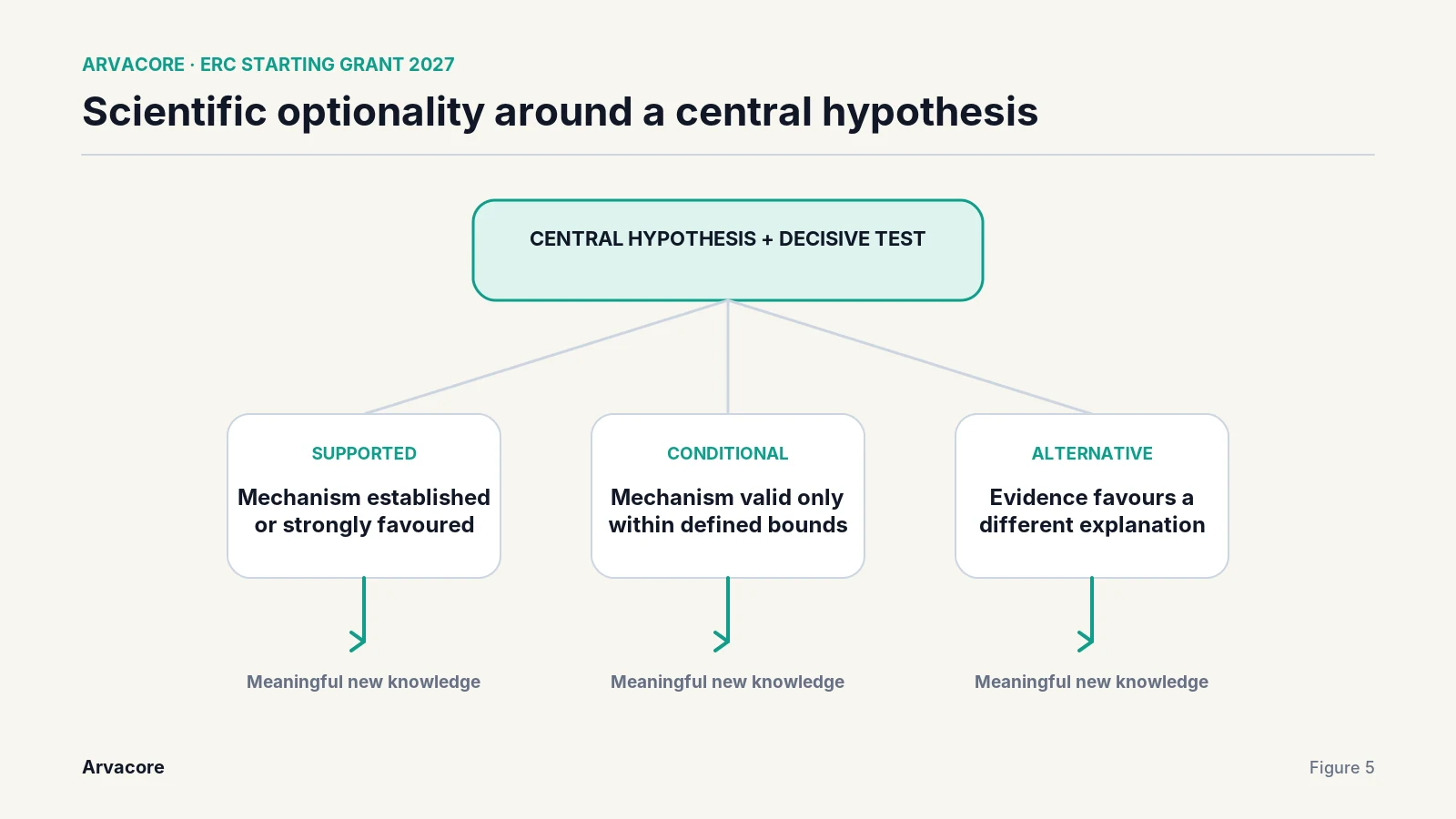
Consider a central hypothesis H.
Outcome A: H is strongly supported.
The project establishes a new mechanism and can explore its consequences.
Outcome B: H is conditionally supported.
The mechanism exists only in a defined regime. The boundary conditions become a scientific result.
Outcome C: H is rejected.
The programme eliminates one explanation, identifies the limits of the current model and redirects attention toward an alternative mechanism.
All three can advance knowledge if the experiments are designed to discriminate between them.
Failure should change the research direction
A proposal should not treat an unexpected result as an administrative problem.
Ask instead:
If the preferred hypothesis fails, what is the next scientifically justified direction?
That direction should emerge from the evidence.
For example:
- absence of the predicted effect may reveal a hidden symmetry or constraint;
- a transition at a different scale may identify a previously neglected interaction;
- failure of a model in one regime may define where a new theory is required;
- a negative experimental result may rule out an entire class of explanations.
The programme can then steer toward the most informative next question.
This is stronger than a generic Plan B because the adaptation follows the science.
Do not remove uncertainty to make the proposal look safe
Applicants sometimes make a bold idea look incremental because they fear reviewers will consider uncertainty a weakness.
That can flatten the proposal.
A better approach is to state the uncertainty precisely and show that the programme is designed around it.
For example:
We do not know whether mechanism A survives in regime B. The project is designed to distinguish A from the two leading alternatives using observables X and Y.
That sentence is stronger than pretending mechanism A is already likely to be correct.
It gives the project a real scientific decision.
Scientific risk should have a proportional payoff
The more uncertain the central proposition, the clearer the potential scientific payoff should be.
A useful test is:
If the strongest outcome occurs, what changes for the field?
The answer should not be "we publish a high-impact paper".
It should describe a change in understanding or capability:
- a long-standing interpretation becomes untenable;
- a new regime becomes experimentally accessible;
- a theoretical limit is shown to be contingent rather than fundamental;
- a new class of measurements becomes possible;
- a previously disconnected set of observations is unified.
High scientific risk earns its place when the upside matters.
Separate risk categories in Part II
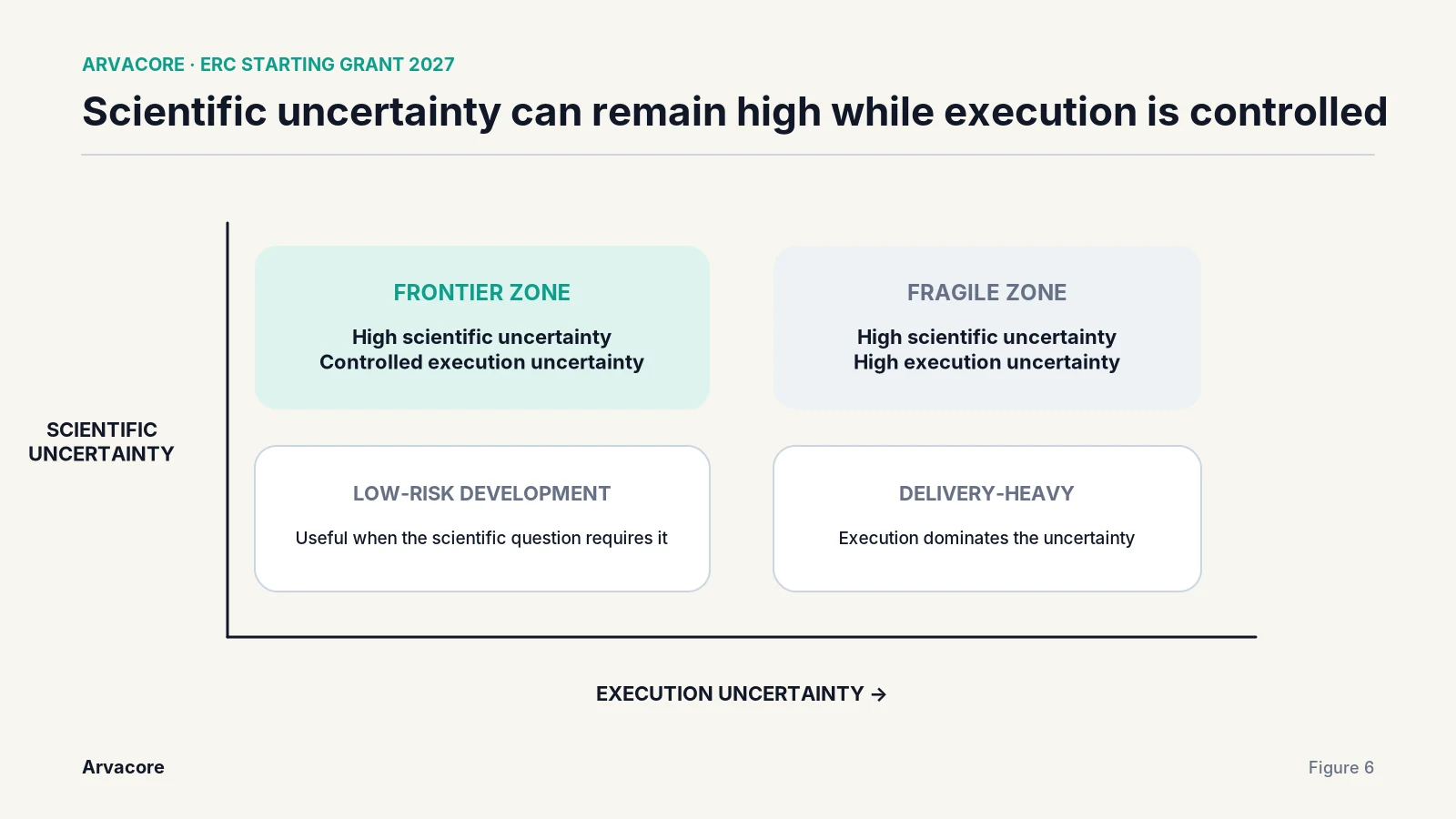
I would separate at least three categories.
Scientific uncertainty
The answer may differ from the preferred hypothesis.
This should be embraced and interpreted.
Methodological uncertainty
A technique may not have enough resolution, selectivity or stability.
This should have an alternative route where possible.
Programme uncertainty
Recruitment, access, sequencing or dependencies may affect delivery.
This should be managed through planning, parallelisation or resource design.
Keeping these categories distinct helps the reviewer see that scientific boldness is intentional while execution is controlled.
Use decision points rather than reassurance
A risk section becomes more credible when it includes explicit decisions.
For example:
If observable X remains below the detection threshold after calibration, the project will switch to observable Y, which probes the same mechanism through an independent physical quantity.
or:
If the expected transition is absent, the programme will map the upper bound and use that bound to discriminate between models A and B.
These statements show how the programme produces information under more than one scenario.
Scientific optionality does not mean adding unrelated backup projects
Optionality should remain inside the same scientific architecture.
A common mistake is to create a backup work package that answers a different, safer question.
That weakens coherence.
A better alternative preserves the central problem while changing the route, observable, model or regime.
The proposal should still feel like one programme.
A useful risk test for the central question
Ask six questions:
- What is genuinely unknown?
- What result would falsify the preferred explanation?
- What is the strongest alternative explanation?
- What evidence discriminates between them?
- What does each plausible outcome teach us?
- What execution risks could prevent us from obtaining interpretable evidence?
If the answers are clear, the project can be both bold and controlled.
The proposal should be committed to the question
A strong ERC proposal does not need to promise that its preferred hypothesis will survive.
It needs to show that the question is important enough to pursue and that the programme has been designed so that nature can answer it.
That is a more scientific form of confidence.
The PI is not promising a particular result. The PI is promising a rigorous programme capable of changing understanding across a meaningful outcome space.