
Part I of the ERC Scientific Proposal is limited to five pages. At Step 1, the evaluation panel assesses Part I together with the CV and Track Record. Part II is not assessed unless the proposal advances to Step 2.
That gives Part I a clear role: it must establish the scientific case for deeper evaluation.
The ERC's own guidance says Part I should present the overall research idea, the current state of knowledge, the scientific questions and objectives, and the overall approach or research strategy. Feasibility details belong in Part II and are assessed at Step 2.
Official sources: Changes to the 2026 and 2027 Work Programmes and ERC Grants: what to expect in 2026 calls.
Treat Part I as a scientific argument
Part I is short enough that every section competes for attention and space.
The document should allow the reviewer to answer, with confidence:
- What is the important scientific problem?
- What does the field currently know?
- What remains unresolved?
- What is the central scientific question?
- What is distinctive about the proposed idea?
- Which objectives will answer the question?
- How will the programme advance knowledge if successful?
This is why I would not write Part I like a compressed methods paper.
Methodological credibility matters, but the detailed implementation belongs in Part II. Part I needs to make the scientific vision intelligible.
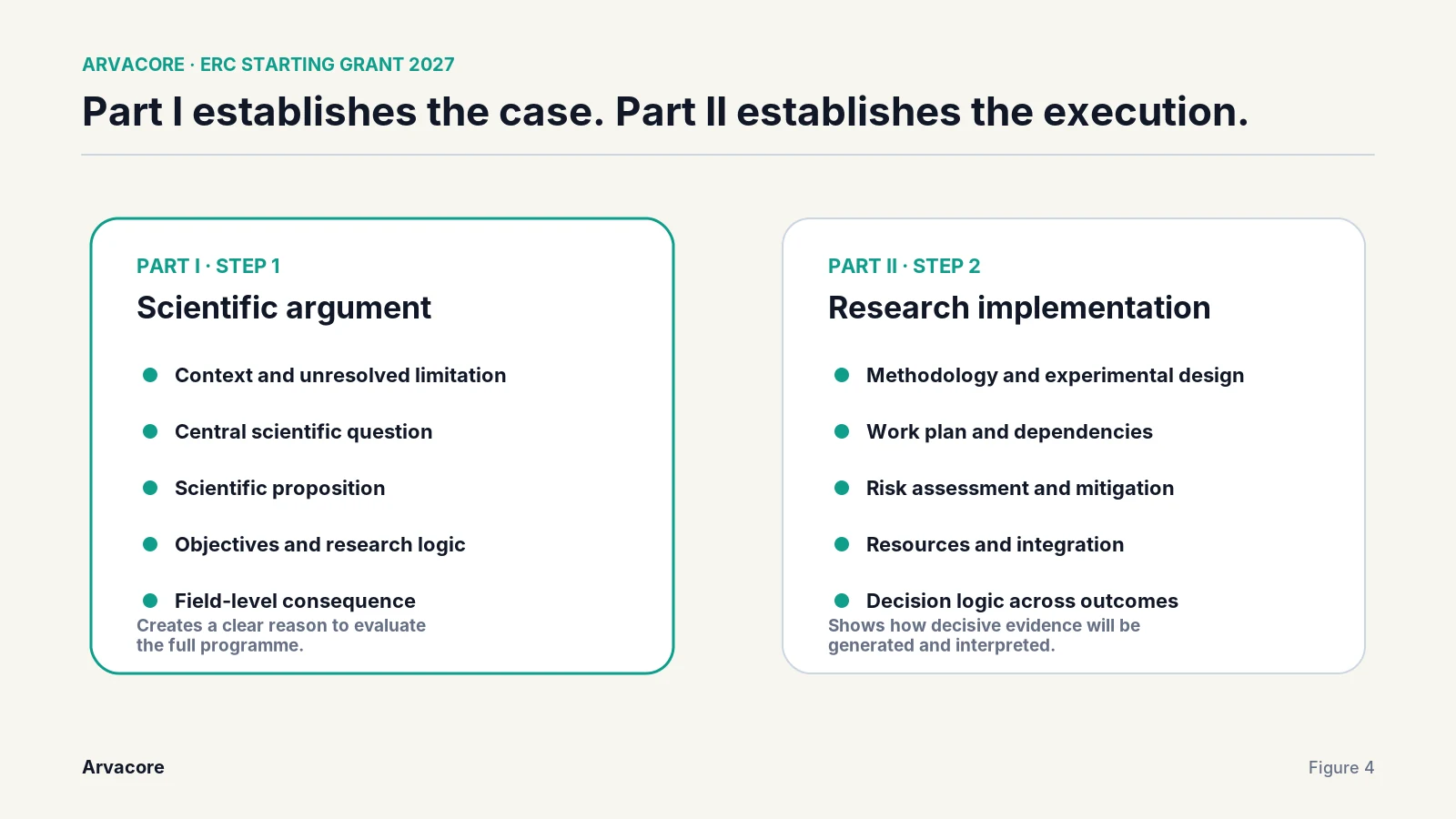
Part I establishes the scientific case and overall strategy. Part II develops implementation, methodology, work plan, risk and mitigation. The two parts should reinforce each other without unnecessary repetition.
Page 1: establish the collision of ideas
The first page should create intellectual tension.
One useful pattern is a collision concept: two facts, observations or accepted ideas that do not sit comfortably together.
For example:
Model A explains the system successfully across regimes X and Y. New observations in regime Z violate a prediction that is central to that model. This proposal tests whether the deviation reveals a second governing mechanism rather than an experimental correction.
The reader immediately sees:
- what is known;
- what is inconsistent;
- why the inconsistency matters;
- what the proposal will investigate.
The exact form varies by discipline. The underlying principle is to reveal the scientific tension early.
Give the reviewer the question early
Do not make the reviewer infer the central question after several pages of literature review.
State it clearly.
For example:
The central question of this programme is whether mechanism X becomes dominant below threshold Y, and whether this transition explains the unresolved behaviour observed in regime Z.
That sentence gives the rest of Part I something to organise around.
The background can then be selected according to whether it helps define the question, show the gap or motivate the approach.
Use the state of the art selectively
The purpose of the state of the art is not to demonstrate that the applicant has read everything.
It should establish:
- the accepted explanation;
- the strongest relevant evidence;
- the important limit;
- why current approaches have not resolved it.
A concise literature discussion can be more persuasive than a dense catalogue of papers when it makes the scientific boundary visible.
The reviewer needs enough context to understand why the question is important and original. Everything else competes with the five-page argument.
Make one strong scientific proposition visible
Once the question is established, explain the idea that makes the project possible.
Depending on the field, this may be:
- a falsifiable hypothesis;
- a new mechanism;
- a theoretical framework;
- a measurement principle;
- a conceptual model;
- access to a previously inaccessible regime.
The proposal should make clear why this proposition is not merely another implementation detail.
Ask:
What becomes testable because of this idea that was not testable before?
That is often the bridge between scientific ambition and research strategy.
A figure can carry part of the scientific argument
A good figure can be extremely valuable in Part I because five pages are restrictive.
The figure has to earn the space it occupies.
I would prioritise a figure that explains one difficult relationship quickly:
- current paradigm versus proposed interpretation;
- unresolved gap and new hypothesis;
- scientific question and objectives;
- possible outcomes and their meaning;
- a new experimental regime that makes the question addressable.
The figure should not be decorative. Avoid graphics that simply repeat the work-package list or add visual complexity without increasing understanding.
A useful test is:
If I remove this figure, do I need several additional paragraphs to explain the same idea?
If yes, the figure is probably doing valuable work.
In a research environment where reviewers increasingly encounter large volumes of polished and AI-assisted text, a genuinely informative scientific figure can also help the proposal retain a clear conceptual identity. The figure must still carry scientific content; visual polish alone has little value.
Use objectives as scientific decisions
Objectives should follow logically from the central question and proposition.
Prefer:
Determine whether interaction X is necessary for transition Y.
rather than:
Characterise samples under conditions A, B and C.
The first tells the reviewer which uncertainty will be resolved. The second describes activity.
For each objective, make clear:
- which part of the central question it addresses;
- what evidence will discriminate between interpretations;
- how its result changes the next scientific decision.
Three or four tightly connected objectives are often easier to understand than a long list of tasks.
Keep feasibility detail in proportion
The current ERC evaluation structure makes this easier than before. Feasibility is not assessed at Step 1; Part II carries methodology, work plan, risk assessment and mitigation for Step 2.
Part I still needs an overall approach or research strategy. The reader must understand the logic of how the question will be attacked.
The distinction is:
Part I: what evidence is needed, why it answers the question, and how the overall strategy fits together.
Part II: exactly how the evidence will be generated, with implementation detail, methods, sequencing, resources, dependencies and contingencies.
This helps preserve space in Part I for the scientific case.
Show the possible scientific outcomes
A high-risk proposal becomes easier to trust when the reader can see what different results would mean.
For example:
- if hypothesis H is supported, the programme establishes mechanism A;
- if H holds only in regime R, the programme defines its boundary conditions;
- if H is rejected, evidence favours mechanism B and changes the interpretation of observation X.
This demonstrates scientific optionality without making the proposal indecisive.
The PI remains committed to resolving the question. The preferred answer remains open to evidence.
A practical five-page allocation
There is no universal page formula, and different fields require different balances. Still, a useful drafting model is:
Opening 0.5-1 page
Scientific problem, collision concept, importance and central question.
Approximately 1 page
State of the art and unresolved limitation, selected tightly around the question.
Approximately 1 page
Central scientific proposition, conceptual framework and why the idea is timely.
Approximately 1.5 pages
Scientific objectives and overall research strategy, with one or two high-value figures where appropriate.
Final 0.5-1 page
Integrated outcome space, field-level consequence and why the programme advances the frontier.
Use this as a planning frame rather than a rigid template. Its purpose is to keep methodology or literature review from consuming the entire argument.
The first page should create a reason to continue
A useful Part I opening produces a specific kind of reaction:
I understand the problem. I can see why it matters. I want to know whether this idea works.
That is stronger than trying to impress the reader with density.
The proposal can be technically sophisticated while remaining conceptually crisp.
Common Part I imbalances
Too much methodology
The document begins to read like a methods paper. The central scientific idea becomes difficult to see.
Too much general motivation
Several paragraphs explain that the broad field is important without identifying the unresolved scientific problem.
Too many objectives
The proposal looks like a portfolio of research activities rather than one programme.
Too much preliminary evidence
The main question begins to look answered already.
Too little outcome logic
The reader understands what the PI will do but not what different results will mean.
Decorative figures
Page space is consumed without reducing conceptual complexity.
These are balance problems rather than rigid prohibitions. The correct allocation depends on the scientific field and the project.
A Part I stress test
Before finalising the five pages, ask a colleague in an adjacent area to read only Part I and answer:
- What is the central question?
- Why does it matter?
- What is the new idea?
- What are the main scientific objectives?
- What would change if the strongest outcome is achieved?
- What happens if the preferred hypothesis is wrong?
If those answers are clear, Part I is performing its scientific function.
If the colleague can explain the methods but cannot explain the question, the emphasis probably needs revision.
Part I should make Part II worth reading
At Step 1, reviewers do not evaluate Part II. Part I therefore needs to stand on its own as a compelling scientific case.
Part II then has a different opportunity: to show that the PI has designed the programme carefully enough to turn scientific ambition into interpretable evidence.
That division is useful. It allows Part I to remain visionary without becoming vague, and Part II to remain rigorous without burying the idea under implementation detail.