
ERC Starting Grant 2027 at a glance
Up to EUR 1.5 million over five years under the standard Starting Grant, with eligible additional funding. The 2027 eligibility window extends from immediately after the PhD defence through the following ten-year period, subject to the detailed ERC rules and applicable extensions.
Open the ERC Starting Grant resource hubAn ERC Starting Grant gives an early-career Principal Investigator the opportunity to establish an independent line of frontier research. The scale is substantial: up to EUR 1.5 million over five years under the standard Starting Grant, with additional funding available for eligible major costs. For the 2027 call, the eligibility window is broader than in previous years: researchers may apply from immediately after the PhD defence and within the following ten-year period, subject to the detailed ERC rules and applicable extensions.
The scientific opportunity is larger than a single experiment or a narrowly defined project. A strong Starting Grant can support a PI-led programme, a research team, several complementary methods and a sequence of decisions that progressively resolve an important scientific question.
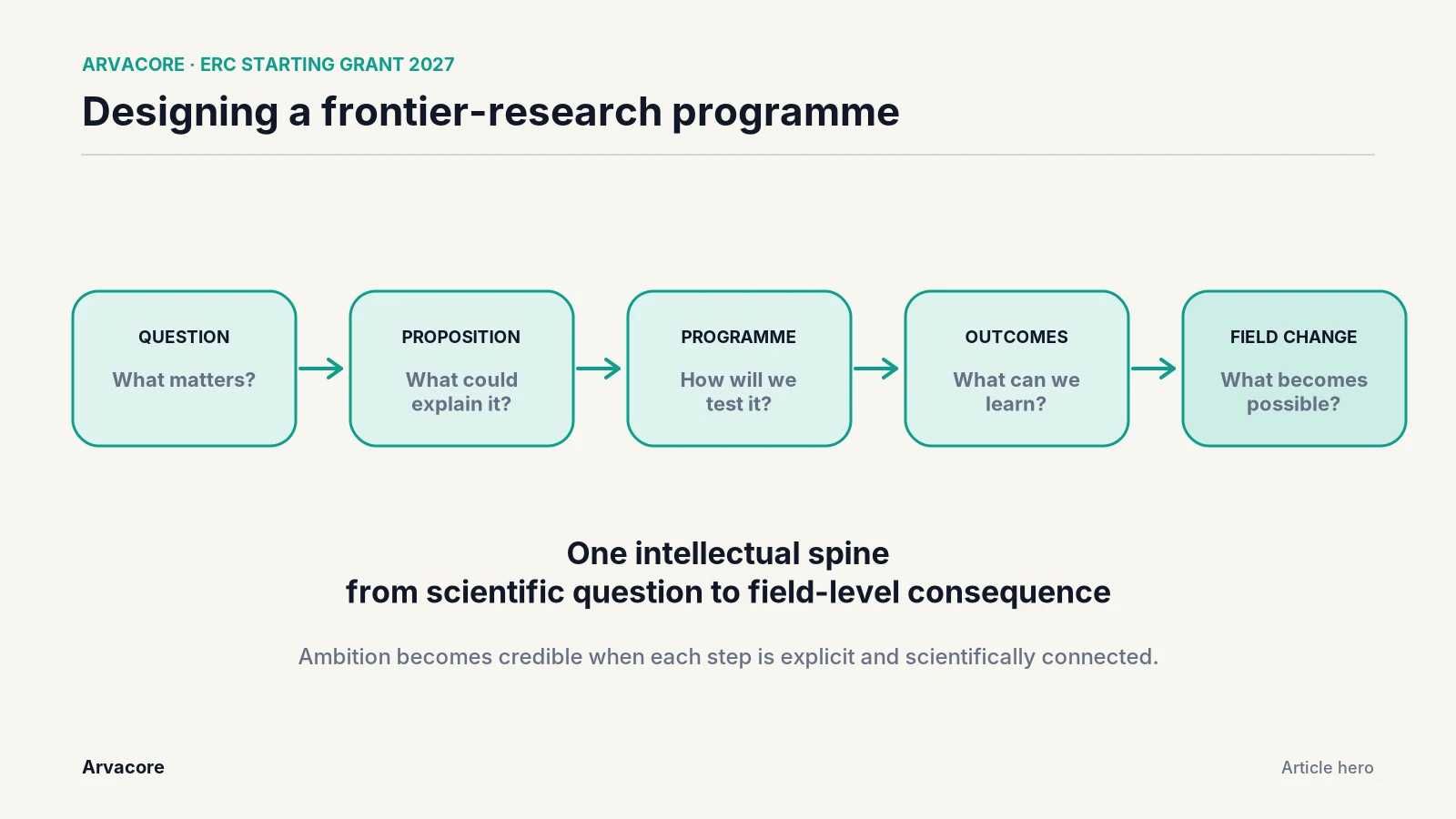
The central design challenge is therefore to create a programme with a clear intellectual spine. The proposal should connect one important question to a testable scientific proposition, a coherent research architecture and a set of outcomes that could materially change how the field thinks or what it can investigate.
This guide focuses on that scientific architecture.
1. Formulate the question before designing the work plan
A research programme becomes easier to evaluate when the scientific question is explicit.
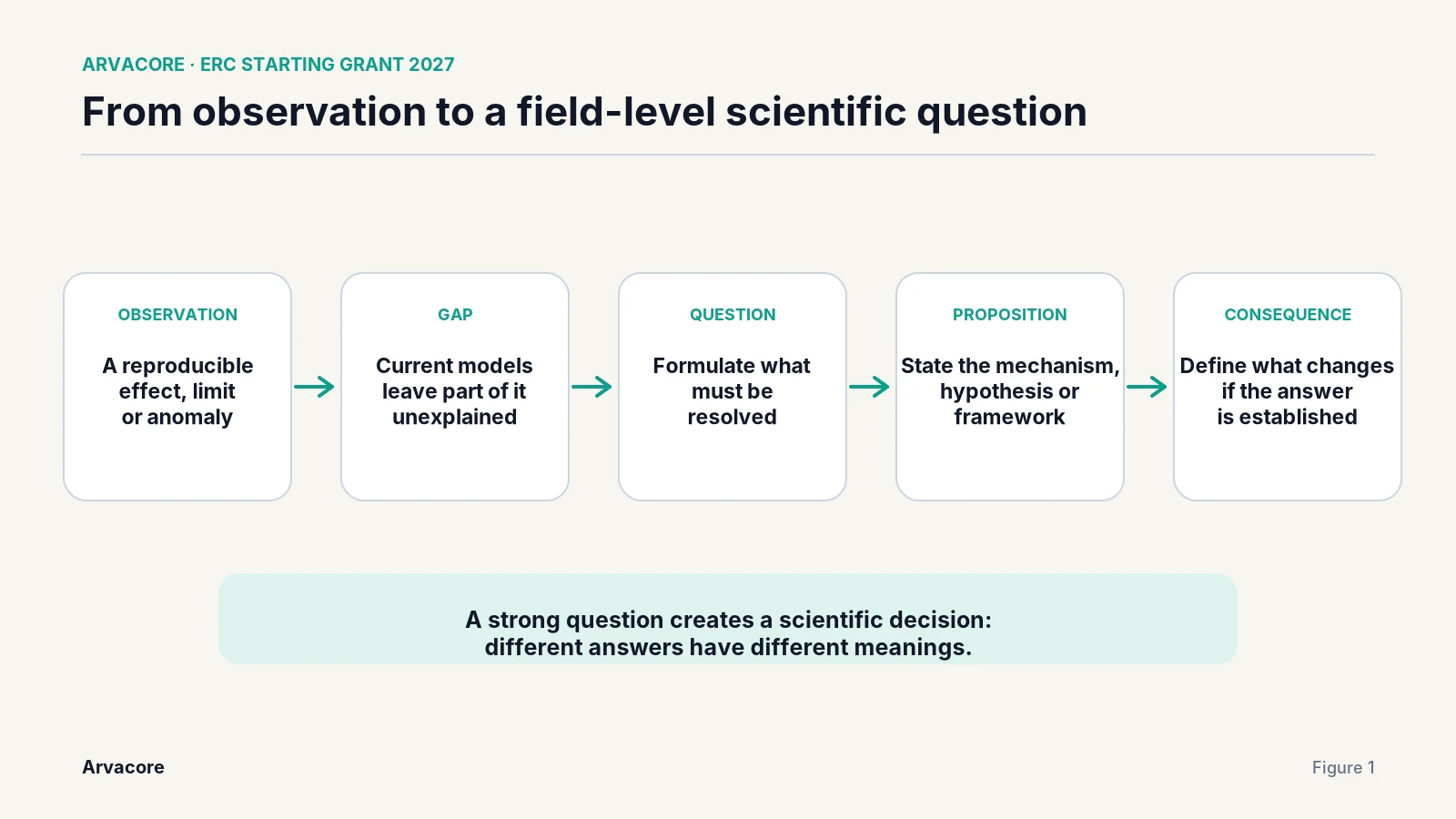
A useful question usually contains four elements:
- A defined phenomenon or limitation. The reader can see exactly what remains unresolved.
- A scientific tension. Current understanding leaves a gap, contradiction or inaccessible regime.
- A route to resolution. The proposal introduces a concept, hypothesis, measurement capability or theoretical framework that makes the question addressable.
- A consequential answer. The result has implications beyond the immediate experiment.
A compact formulation is:
What governs X under Y conditions, and does mechanism Z explain the transition that current models cannot account for?
The exact form will vary by discipline. The important point is that the question creates a research decision. Different answers should have different scientific meanings.
This structure is stronger than beginning with activities such as fabrication, simulation, measurement or data collection. Those activities become valuable once the reader understands what scientific uncertainty they resolve.
For a focused framework for this step, see How to formulate an ERC scientific question.
2. Move from a technical challenge to a scientific problem
The distinction matters in experimental sciences, engineering, quantum technologies, materials, photonics, computation and other technology-intensive fields.
Consider a hypothetical system whose sensitivity saturates below a given operating regime. A technical framing might ask how to improve the sensitivity. A scientific framing can go deeper:
Which mechanism creates the apparent sensitivity limit, and is that limit fundamental or a consequence of an assumption built into the present architecture?
The technical objective may still be achieved. The scientific proposal, however, now has broader value because it tests the origin of the limitation.
This shift changes the project from optimisation to explanation.
A useful diagnostic is to ask what knowledge would remain valuable if the targeted device, material or method did not reach the preferred performance metric. If the programme still resolves an important mechanism, boundary condition or principle, the scientific core is usually stronger.
3. State the central scientific proposition
The proposal benefits from one identifiable proposition around which the programme is organised. Depending on the field, this may be a hypothesis, a new theoretical framework, a predicted mechanism, a new experimental regime or a conceptual model.
The proposition should be specific enough to guide experiments and broad enough to organise several objectives.
For example:
We hypothesise that the observed transition is controlled by mechanism B rather than mechanism A once the system enters regime C.
That statement creates a clear programme:
- establish whether regime C is genuinely distinct;
- identify observables that discriminate A from B;
- test the transition under controlled perturbations;
- determine the boundary conditions of the mechanism;
- examine whether the principle generalises beyond the initial system.
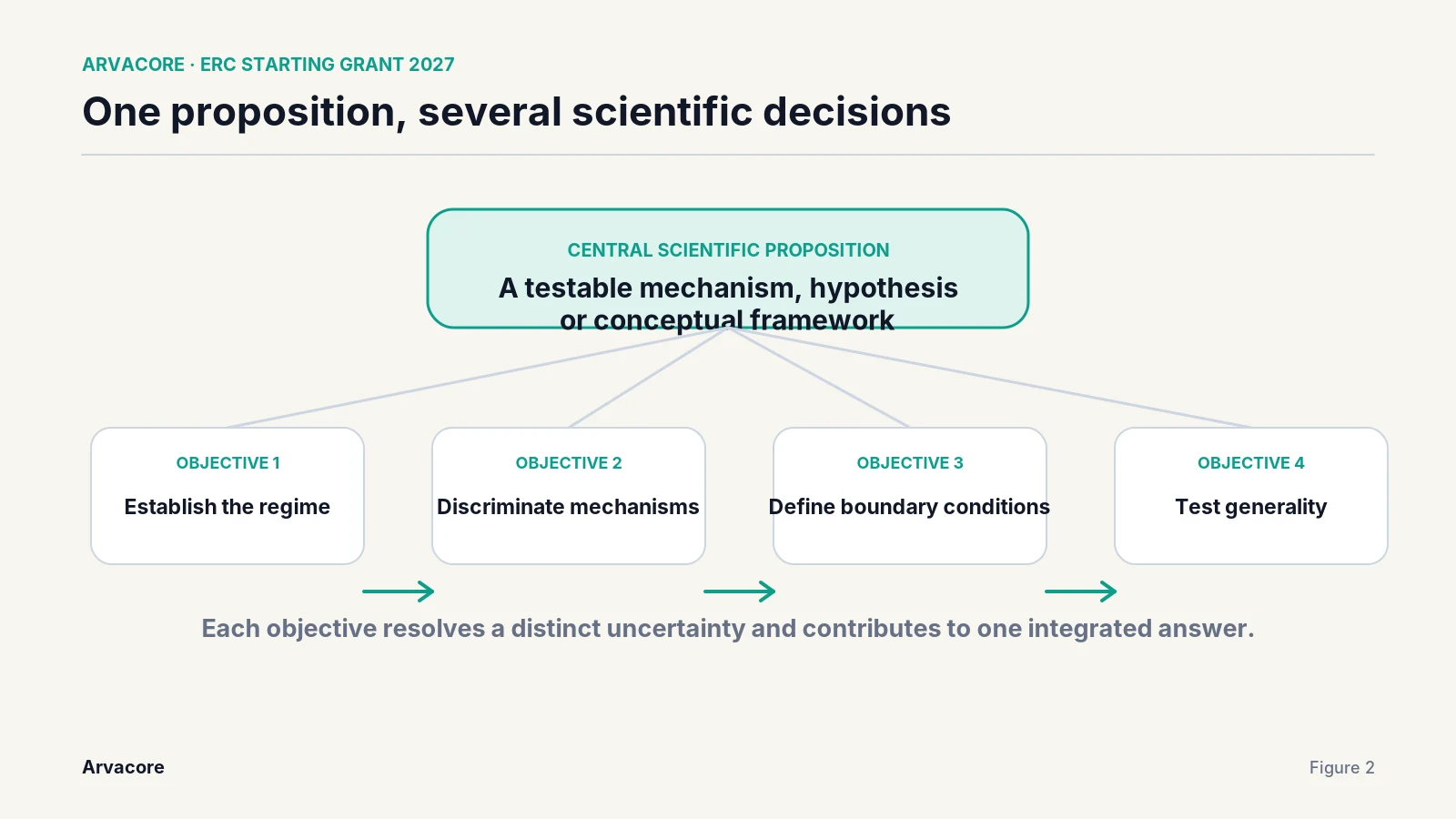
This architecture also helps the PI decide what to leave out. A technically interesting activity belongs in the core programme when it strengthens the central scientific argument; otherwise it can sit naturally as supporting work.
4. Define ambition in terms of distance travelled by the field
Scientific ambition is best expressed as a change in understanding or capability.
The following progression is useful when testing the scale of the idea:
- Improvement - an existing method performs better.
- Extension - an established concept is tested in a new regime.
- Explanation - the programme resolves why an important phenomenon occurs.
- Reframing - the result changes the conceptual interpretation of the phenomenon.
- New capability - the programme makes a new class of scientific questions experimentally or theoretically accessible.
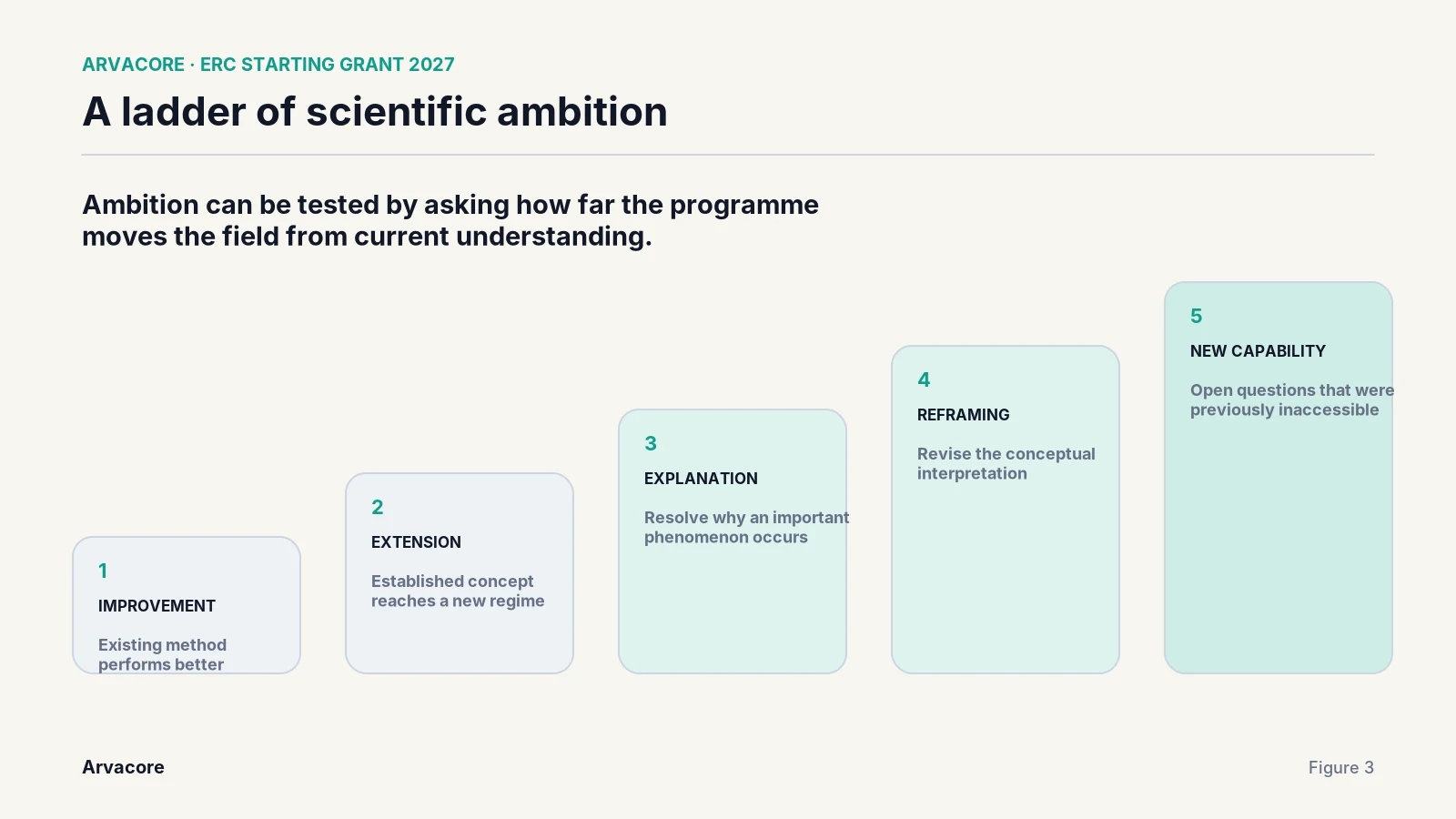
A Starting Grant can be highly ambitious without claiming that an entire discipline will be overturned. Precision is more persuasive than exaggeration. The proposal should show exactly which assumption, boundary, measurement capability or scientific question could move if the work succeeds.
A useful sentence to complete during proposal development is:
If the programme reaches its strongest outcome, the field will be able to ________ for the first time, or will need to revise ________.
That sentence forces the ambition to become concrete.
A separate guide develops the ambition test in more depth: How ambitious should an ERC Starting Grant be?.
5. Design objectives around knowledge decisions
Objectives work best when they resolve scientific uncertainty rather than describe activity.
Compare the following formulations:
Activity-oriented objective:
Fabricate and characterise device X.
Knowledge-oriented objective:
Determine whether mechanism X remains dominant below the predicted transition threshold.
The second formulation identifies the scientific decision produced by the work.
For each objective, ask:
- What uncertainty does this objective resolve?
- Which observation would change our interpretation?
- What result would support the central proposition?
- What result would lead to a revised model?
- Which later objective depends on this answer?
The work plan then becomes a logical sequence of scientific decisions rather than a list of tasks.
6. Treat Part I as the scientific argument
The ERC proposal structure introduced for the 2026 calls continues to shape how applicants should think about the document. Part I of the Scientific Proposal is the material seen at Step 1, together with the CV and Track Record. Part II is evaluated at Step 2 and carries the detailed implementation, methodology, work plan, risk assessment and mitigation.
This makes the role of Part I unusually clear: it must establish why the scientific idea deserves deeper evaluation.
A useful Part I sequence is:
6.1 Scientific context
State what the field currently understands. Select only the background required to define the problem.
6.2 Unresolved limitation
Identify the observation, contradiction, inaccessible regime or conceptual gap that motivates the programme.
6.3 Central question
Write the question in a form that can be answered by the research programme.
6.4 Scientific proposition
Introduce the idea that makes the question tractable. Show why it is distinctive and why it is timely.
6.5 Objectives and research logic
Explain how the objectives jointly test the proposition and answer the central question.
6.6 Scientific consequence
State what the main possible outcomes would mean for the field.
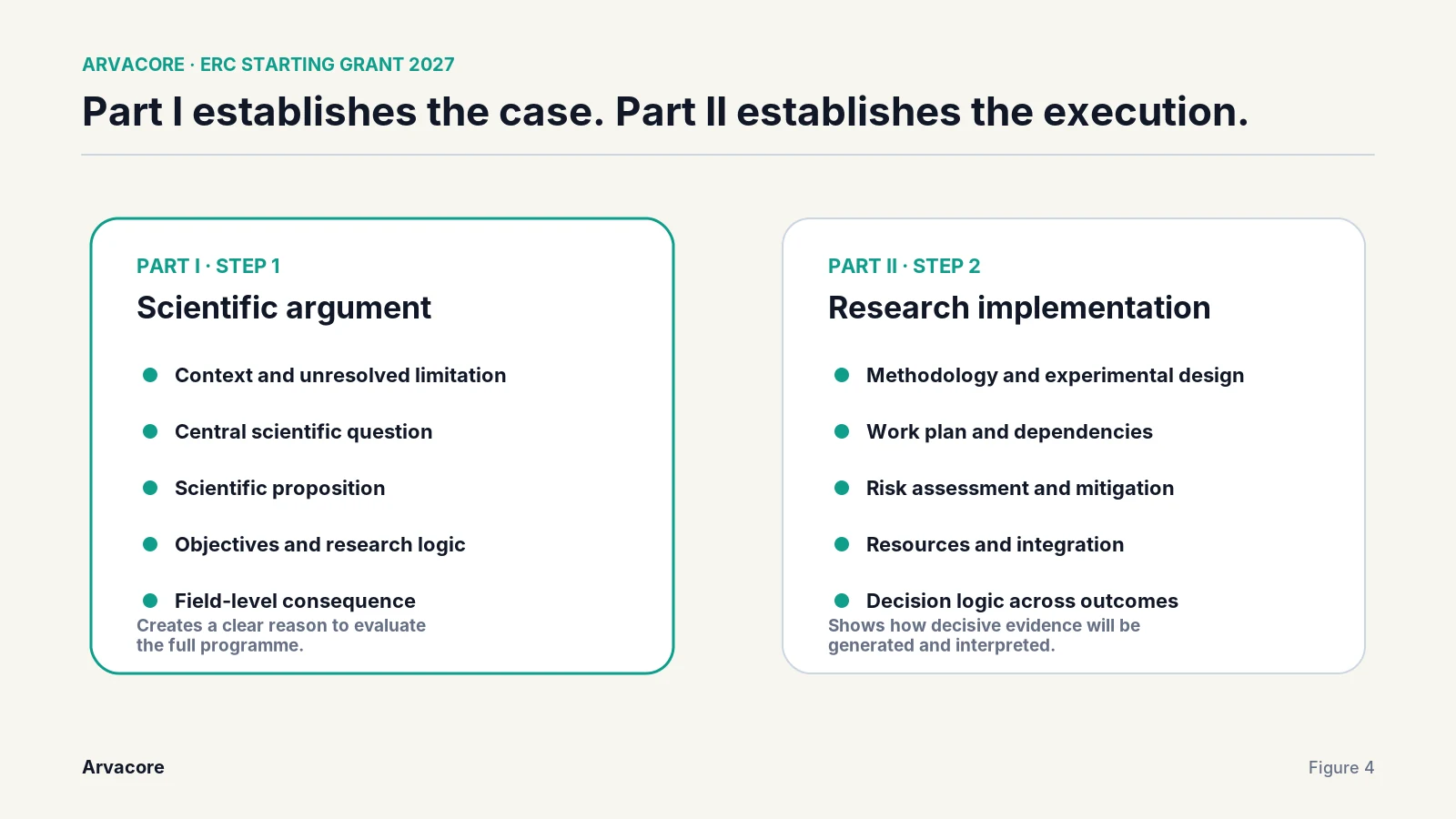
A strong Part I gives the reader sufficient information to understand the importance, originality and scientific logic of the proposal. It also creates a clear reason to examine the implementation in Part II.
For the five-page Step 1 argument, see the ERC Part I / B1 guide.
7. Use Part II to convert scientific ambition into confidence
Part II has a different job. It should show that the programme can generate interpretable evidence at the required level of ambition.
This is where methodology, sequencing, experimental design, theoretical methods, dependencies, milestones, risk assessment and mitigation become central.
The strongest Part II sections connect implementation decisions directly to scientific questions.
For example:
Objective 2 discriminates between mechanisms A and B. Method M1 measures observable O1, while M2 provides an independent test through O2. Agreement between the two observables supports mechanism B. Divergence triggers the alternative model defined in Objective 3.
This is more informative than stating that two methods will be used. It explains why they are scientifically necessary and how their outputs will be interpreted.
For implementation depth, see the ERC Part II / B2 guide.
8. Use figures to compress reasoning
A scientific figure can carry a large fraction of the conceptual load of the proposal.
The most useful figures tend to perform one of four functions:
- define the problem, by showing where current understanding becomes insufficient;
- show the hypothesis, by visualising the proposed mechanism or conceptual change;
- show the research logic, by connecting objectives and decisions;
- show the outcome space, by making multiple scientifically meaningful results explicit.
The figure should remain interpretable after a short inspection. Labels should be declarative, relationships should be visually obvious and decorative complexity should be kept low.
A particularly valuable first figure can combine the current paradigm, the unresolved gap and the new proposition. This gives the reviewer a visual model of the project that can be recalled throughout the document.
In a text-dense evaluation environment, this matters. A concise conceptual figure creates an anchor that prose can then develop with full scientific detail.
For visual strategy and examples, see How to use figures in an ERC proposal.
9. Build high-risk research with scientific optionality
Ambitious research contains uncertainty. The project becomes more robust when several plausible outcomes generate useful scientific knowledge.
Consider a central hypothesis H and a decisive experiment E.
- Outcome A: H is strongly supported. The proposed mechanism becomes the leading explanation.
- Outcome B: H is supported only within a restricted regime. The project defines the boundary conditions and motivates a refined model.
- Outcome C: the evidence favours an alternative explanation. Competing mechanisms gain weight, and the project defines which assumption in the current model needs revision.
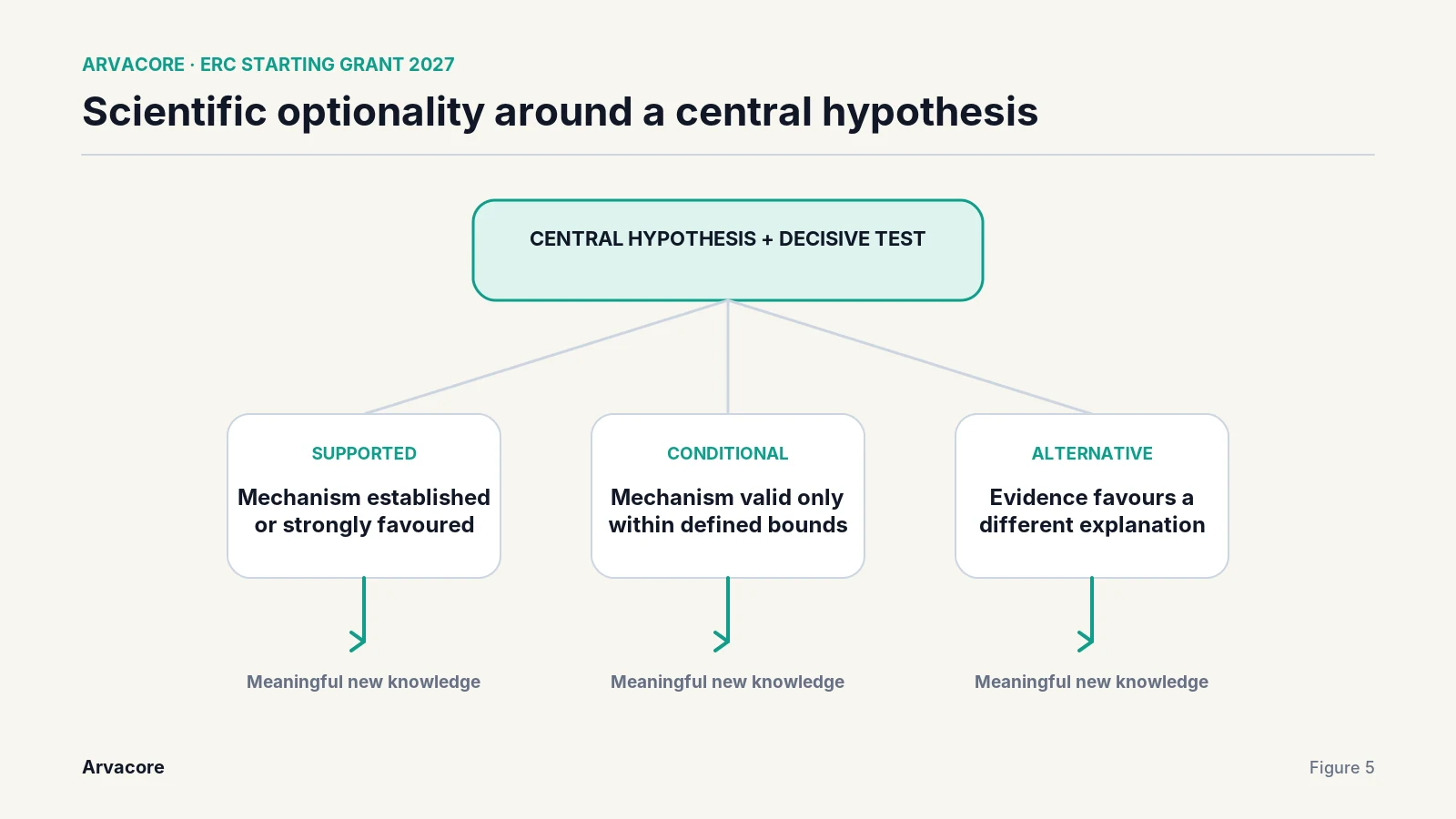
I call this scientific optionality: the programme is built to resolve the question across more than one meaningful outcome.
The proposal can therefore be bold while remaining rigorous. The preferred hypothesis may be revised, while the research programme continues to produce interpretable knowledge because the outcome space has been designed in advance.
The dedicated scientific risk guide develops this outcome-based approach.
10. Separate scientific uncertainty from execution uncertainty
The two forms of risk play different roles.
Scientific uncertainty concerns the answer: the mechanism may differ from the hypothesis, the predicted transition may shift, or a new regime may emerge.
Execution uncertainty concerns whether the programme can obtain interpretable evidence: an instrument may lack the required resolution, a sample may be inaccessible, recruitment may take longer than planned, or a critical method may not reach the required performance.
ERC-scale ambition can accommodate substantial scientific uncertainty. Execution uncertainty should be actively controlled through method selection, redundancy, access planning, staged validation and alternative routes.
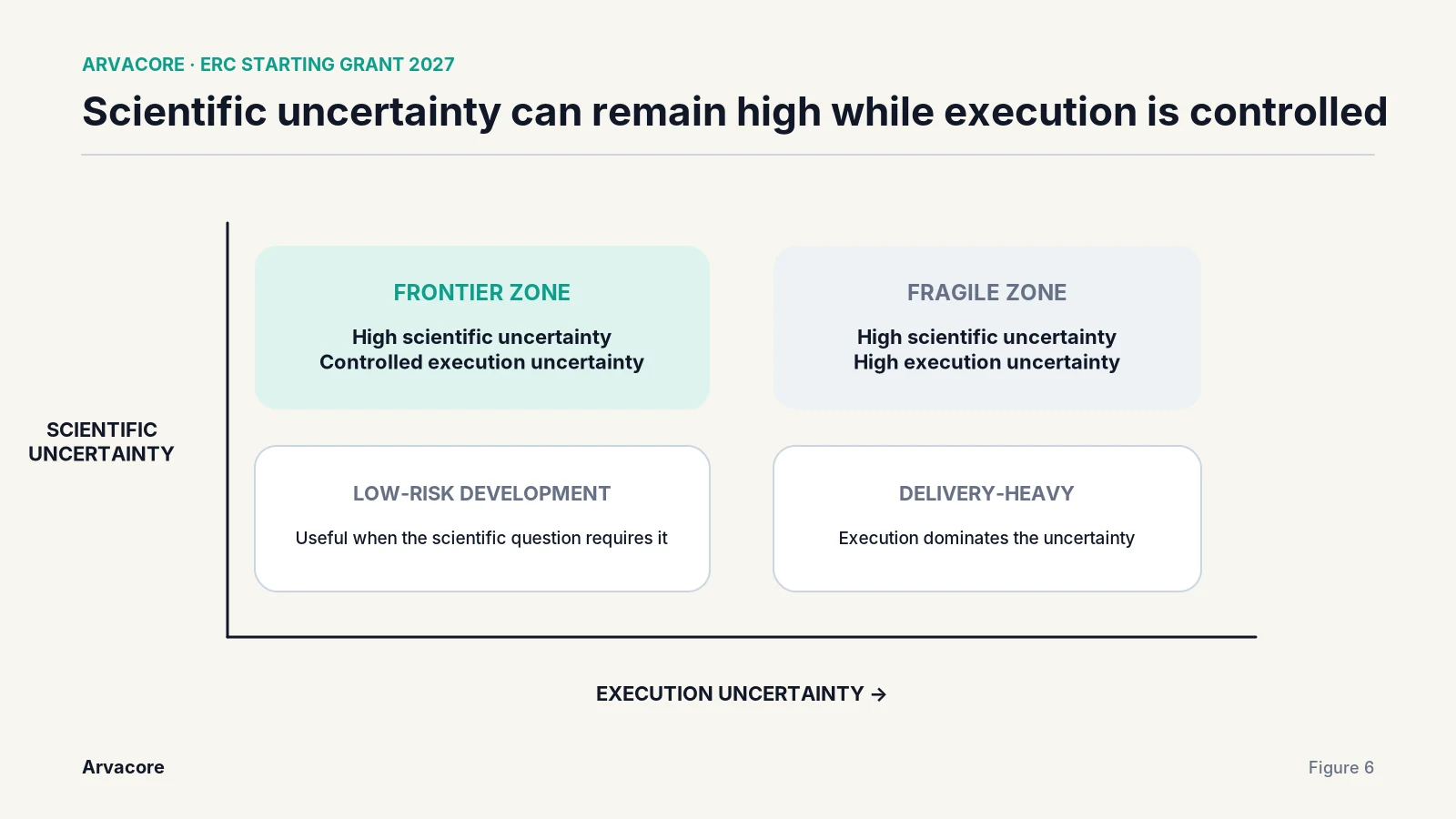
This distinction also improves the risk section in Part II. Scientific risk should be expressed through hypotheses and outcome interpretation. Execution risk should be expressed through concrete mitigation measures.
11. Design a PI-led programme rather than a collection of mini-projects
A Starting Grant is centred on the Principal Investigator, while the research itself can involve a substantial team. Doctoral researchers, postdoctoral researchers, engineers, theorists, computational scientists, experimentalists and external collaborators may all contribute where scientifically justified.
The architecture should make the PI's intellectual ownership visible.
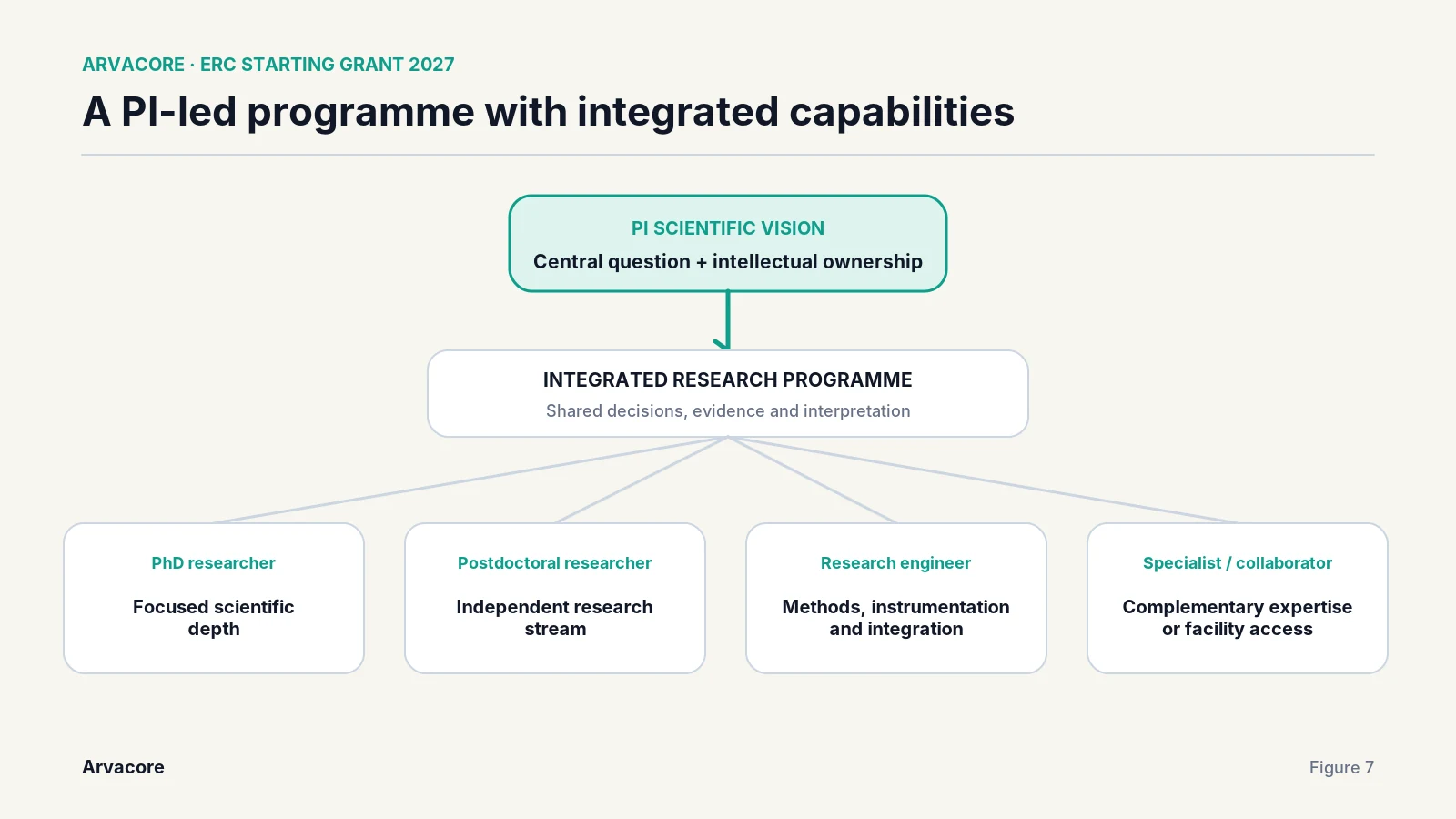
A useful team-design question is:
Which capability is required to answer the scientific question, and at what stage does that capability become necessary?
This produces a more credible staffing logic than assigning one person to each work package by default.
It also helps justify resources. Each role has a clear relationship to a scientific objective, method or integration task.
For team architecture, see How to build an ERC Starting Grant research team.
12. Use preliminary evidence to open the question
Preliminary results can be powerful when they establish access, reveal an unexplained effect or show that a decisive measurement is possible.
The strongest preliminary evidence often creates a productive tension:
We can now observe the regime where the question becomes testable, and the initial evidence suggests that the accepted explanation is incomplete.
This supports the feasibility of the programme while preserving genuine scientific uncertainty.
The same principle applies to published work. The PI's track record should demonstrate the ability to reach the frontier of the problem. The proposal should then show a clear intellectual step beyond that established work.
The evidence balance is developed further in ERC preliminary results: how much evidence is enough?.
13. Make the project falsifiable and interpretable
A central hypothesis becomes more useful when the proposal states what would count as support, partial support and contradiction.
For a key claim, define:
- the predicted observation;
- the discriminating measurement or analysis;
- the alternative explanation;
- the boundary conditions;
- the interpretation of an unexpected result.
This often leads to stronger milestones.
A milestone such as "prototype completed" confirms an activity. A milestone such as "mechanisms A and B discriminated across the predicted transition regime" confirms a scientific decision.
Both types may be necessary, yet the second one communicates the knowledge progression of the programme.
14. Define success at several scientific levels
A frontier-research programme benefits from a layered definition of success.
Core scientific success
Resolve the central uncertainty and establish which explanation is consistent with the evidence.
Strong scientific success
Validate the new mechanism or framework and define its operating boundaries.
Transformative scientific success
Create a new capability, establish a new conceptual model or open a research direction that was previously inaccessible.
These levels make the ambition transparent. They also help the reviewer understand how the programme remains valuable across a range of scientifically plausible outcomes.
15. Use interdisciplinarity only where the question requires it
Interdisciplinary work is strongest when the scientific problem genuinely crosses disciplinary boundaries.
A proposal combining physics, AI, materials science and engineering is strongest when it shows why those disciplines become interdependent in answering the central question.
For example:
- theory identifies the discriminating observable;
- fabrication creates access to the required regime;
- experiment measures the response;
- computation separates competing mechanisms;
- an integrated model tests whether the result generalises.
The disciplines then form one scientific chain rather than parallel work streams.
16. Write for experts who are adjacent to the exact problem
ERC panels contain excellent scientists. Their expertise may be broader than the specific sub-problem of the proposal.
The writing should therefore preserve scientific depth while keeping the logic visible.
A useful paragraph pattern is:
Claim -> evidence -> implication.
For example:
Existing models predict a monotonic response below temperature T. Three independent measurements instead show a reproducible transition in the same regime. This discrepancy suggests that the standard model omits a competing mechanism that becomes dominant below T.
The reader receives the scientific point first, the evidence second and the reason it matters third.
Long literature surveys can then be reduced to the references that define the scientific tension.
17. Make the first conceptual figure work hard
The first figure deserves disproportionate attention because it can establish the mental model for the entire proposal.
A good first figure should answer three questions:
- What does the field currently understand?
- Where does that understanding become insufficient?
- What new proposition will the ERC programme test?
A declarative caption is useful. Instead of "Overview of the project", a stronger caption could be:
The programme tests whether the apparent limit is fundamental or emerges from an untested assumption in the current model.
The figure then becomes part of the argument rather than an illustration of the document structure.
18. Stress-test the proposal before writing the full document
Before expanding the application, I would ask the PI to answer the following questions in one or two pages.
Scientific question
What is the single question that organises the programme?
State of knowledge
What does the field currently believe or understand?
Limitation
Which observation, regime or mechanism remains unresolved?
Proposition
What new hypothesis, framework or capability makes the question addressable?
Decisive evidence
Which experiment, calculation, dataset or analysis would genuinely discriminate between plausible explanations?
Outcome space
What would the main plausible results mean scientifically?
Field-level consequence
What could researchers understand, measure or ask after the project that they cannot do today?
PI fit
Which elements of the PI's trajectory demonstrate the ability to lead this programme, and where does the proposal establish a distinct independent direction?
Team logic
Which complementary capabilities are required, and how do they integrate around the central question?
If these answers form a coherent chain, the proposal has a strong scientific skeleton. The detailed work packages, resources and timetable can then be built around that skeleton.
Before finalising a draft, use the common mistakes guide and final proposal checklist.
19. A compact architecture for the full proposal
The complete scientific narrative can be represented as:
- Scientific context - establish the minimum background required to understand the problem.
- Unresolved limitation - define the point where current understanding becomes insufficient.
- Central question - formulate the problem in an answerable form.
- Scientific proposition - introduce the hypothesis, mechanism or conceptual framework.
- Objectives - define the scientific decisions needed to resolve the question.
- Research programme - describe the methods, sequencing and integration required to generate decisive evidence.
- Outcome logic - state how the main plausible results will be interpreted.
- Field-level consequence - explain how the strongest outcome would change understanding or capability.
- Team and resources - show how people, equipment and collaborations map onto the scientific programme.
- Risk and optionality - preserve high scientific ambition while controlling execution risk.
This architecture gives Part I and Part II a common intellectual spine while allowing each section to perform its distinct role.
Conclusion
The most compelling ERC Starting Grant proposals combine ambition with structure.
They begin with a scientific question that matters beyond one experiment. They state a proposition that can be tested. Their objectives resolve distinct uncertainties. Their figures clarify the conceptual argument. Their team design follows the needs of the science. Their risk logic protects interpretability while preserving genuine uncertainty about the answer.
The proposal therefore becomes more than a sequence of activities. It becomes a PI-led research programme designed to move a field from one state of understanding to another.
A useful final test is:
If the strongest outcome is achieved, what will researchers in this field be able to understand, measure or ask that they cannot today?
A precise answer to that question is a strong signal that the programme is operating at the right level of ambition for an ERC Starting Grant.
Continue through the ERC hub
Use the ERC Starting Grant 2027 applicant hub for eligibility, panel choice, budget, evaluation, interview preparation and the full question-led resource cluster. If you prefer a fast navigation layer, see 30 questions researchers ask about ERC Starting Grants.
Request a fit check
If you are deciding whether an idea has the scientific shape for ERC, share the programme stage and central research question. Arvacore will confirm the smallest useful next step before any paid work starts.
Alessandro Brunetti, DPhil
University of Oxford
Founder, Arvacore
This article presents Arvacore's scientific strategy perspective and is not official ERC guidance. Applicants should always consult the current ERC Work Programme, the Information for Applicants and the Funding & Tenders Portal.
Official sources
- European Research Council, Starting Grant: https://erc.europa.eu/apply-grant/starting-grant
- European Research Council, ERC Work Programme 2027 announcement: https://erc.europa.eu/news-events/news/new-erc-work-programme-sets-out-2027-funding-opportunities
- European Research Council, Applying for an ERC grant in the 2027 competitions: https://erc.europa.eu/news-events/news/applying-erc-grant-2027-competitions-what-you-need-know
- European Research Council, Changes to the 2026 and 2027 Work Programmes: https://erc.europa.eu/news-events/news/changes-2026-and-2027-work-programmes
- European Research Council, ERC Grants: what to expect in 2026 calls: https://erc.europa.eu/news-events/events/erc-grants-what-expect-2026-calls