
Preliminary results are not mandatory for an ERC Starting Grant. The ERC explicitly allows the PI to decide whether preliminary evidence is useful and where it belongs in Part I or Part II.
That flexibility matters.
My preferred principle is:
Show enough to make the question plausible. Preserve enough uncertainty to justify the research programme.
A proposal can be strong with no preliminary data in some fields. A small amount of evidence can be very useful. A large body of evidence can sometimes make the central question look already answered.
Official source: ERC proposal guidance and webinar Q&A
Preliminary evidence has several possible jobs
Evidence can help an ERC proposal by showing that:
- an unexplained phenomenon is real;
- a critical experimental regime is accessible;
- a new method can reach the required order of magnitude;
- a theoretical prediction is worth testing;
- the PI has access to a unique capability;
- a surprising observation opens a larger scientific question;
- a difficult enabling step is technically plausible.
These are different functions.
The proposal should be clear about which one the evidence serves.
Evidence should support the question, not replace it
Suppose the main hypothesis is H.
If the preliminary data already demonstrate H convincingly, the reviewer may reasonably ask what remains to be discovered over five years.
A stronger use of evidence might be:
Preliminary observation X is inconsistent with the accepted explanation and is compatible with H, but does not discriminate H from alternatives A and B. The ERC programme will make that discrimination possible.
Now the evidence establishes the problem while preserving the research question.
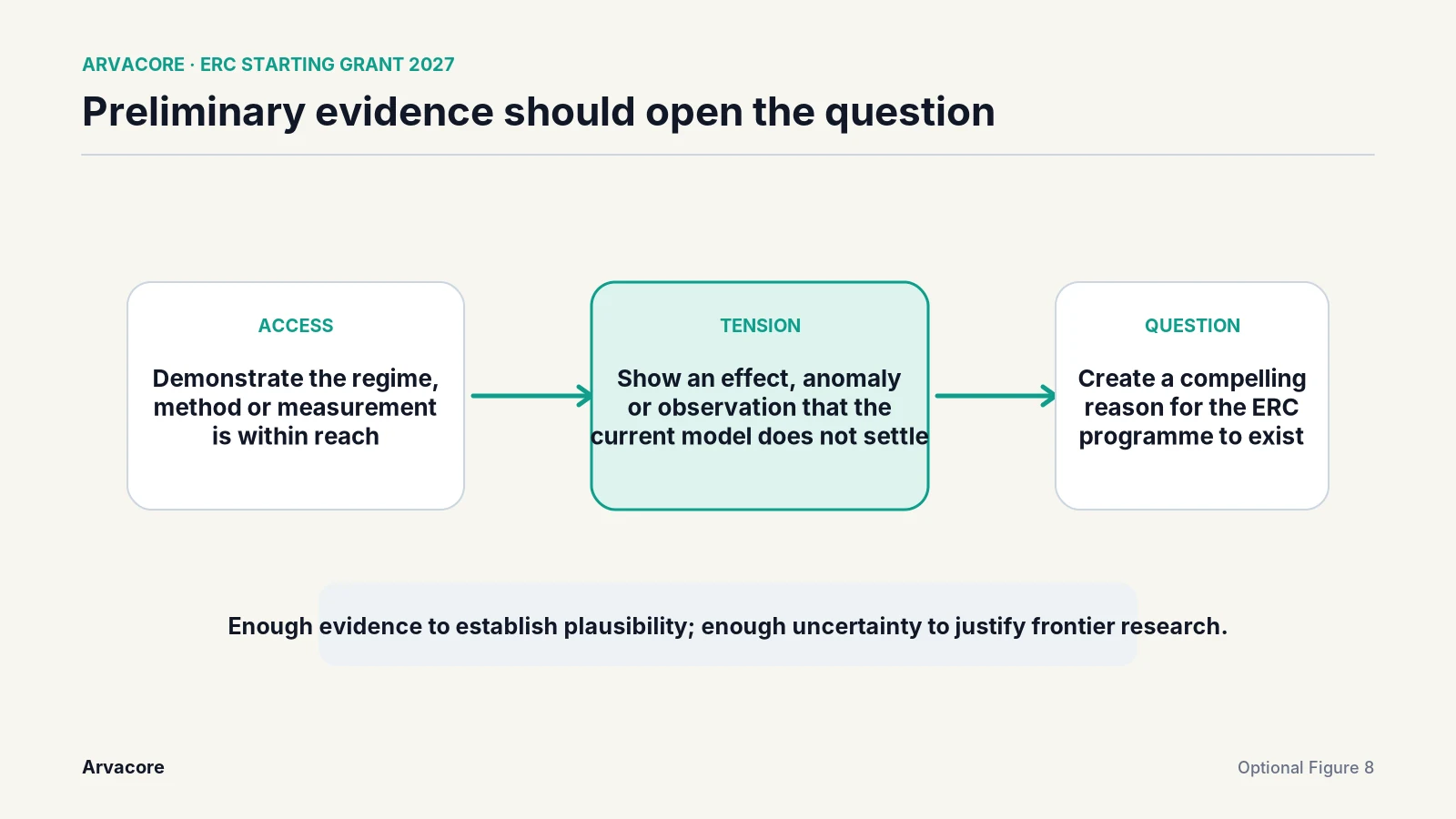
Preliminary evidence is most useful when it establishes plausibility and access while leaving a meaningful scientific uncertainty for the ERC programme to resolve.
No preliminary data can be scientifically legitimate
Some projects begin from theory, conceptual synthesis, archival material, a new mathematical conjecture, a novel method, or a question that requires equipment the grant itself will create.
In these cases, absence of preliminary data is not automatically a weakness.
The proposal still needs a credible scientific basis. That basis may come from:
- published evidence from the field;
- a contradiction between established results;
- a new theoretical derivation;
- a well-supported mechanism;
- a clear methodological route;
- the PI's demonstrated expertise in adjacent work.
The key is whether the proposal gives the reviewer a rational basis for believing the question is worth pursuing.
A little evidence can have high value
One well-chosen result can do more than several pages of data.
Examples include:
- one trace showing an unexpected regime;
- one microscopy image demonstrating access to the relevant structure;
- one simulation establishing that the effect could be large enough to test;
- one pilot dataset showing that the signal exists;
- one prototype measurement demonstrating feasibility of a new observable.
The value comes from what the result establishes conceptually.
A preliminary figure should therefore answer a question such as:
Why is this idea scientifically plausible now?
or:
What observation makes the larger question unavoidable?
Too much evidence can reduce the perceived frontier
This is field-dependent, but it is worth testing.
If the proposal contains:
- the central effect already demonstrated;
- the key mechanism already identified;
- the decisive method already validated;
- the expected conclusion already strongly supported;
then the remaining programme may look like extension, optimisation or completion.
That can still be excellent science. It may simply need a different central question.
The ERC proposal should preserve a meaningful unknown.
Distinguish evidence of capability from evidence of answer
These are often confused.
Evidence of capability shows that the PI can perform the research.
For example:
- the group can fabricate the required structure;
- the laboratory can reach the relevant temperature;
- the team can analyse the required data type;
- the PI has developed the necessary theoretical framework.
Evidence of answer shows that the central scientific conclusion is already likely correct.
The first can strengthen feasibility. The second can narrow the research question if overdeveloped.
A useful proposal often contains strong evidence of capability and limited evidence about the final answer.
Decide whether the evidence belongs in Part I or Part II
Use Part I when the result is essential to the scientific argument.
For example:
This unexplained observation is the reason the central question exists.
Use Part II when the result mainly supports implementation.
For example:
We have demonstrated that the measurement platform reaches the required noise floor.
The distinction helps protect Part I from becoming a methods paper.
Preliminary data should create tension
The best preliminary evidence often produces the reaction:
Something important is happening here, and we do not yet know why.
That is a strong place to begin frontier research.
The evidence gives the reviewer confidence that the question is not arbitrary. The uncertainty gives the programme a reason to exist.
A five-question test
Before including preliminary evidence, ask:
- What precise claim does this result support?
- Does the proposal need this evidence to make the question credible?
- Does it demonstrate capability, scientific tension or both?
- Does it accidentally make the main hypothesis look already solved?
- Is the figure or paragraph worth the page space it consumes?
If the evidence cannot answer one of these questions, it may not belong in the proposal.
The goal is plausibility, not certainty
An ERC Starting Grant is not a request to finish a nearly completed study.
The proposal can show enough evidence to establish seriousness, access and scientific logic while leaving the decisive answer genuinely open.
That balance is different in experimental physics, mathematics, life sciences, social sciences and engineering. The principle remains useful across fields: the evidence should justify the question, not eliminate it.