
An ERC Starting Grant should contain enough scientific ambition that the strongest outcome matters beyond the immediate project. The proposal still needs a precise programme, but the vision behind that programme should reach further.
My preferred test is simple:
Can this programme create important work for the field for the next 10-15 years?
The question is deliberately larger than publication count, technical performance or the number of experiments. It asks whether the project can open a scientific direction.
Ambition begins with the importance of the question
Strong research makes the significance of the problem visible early. The reviewer should understand why the question matters before encountering extensive methodological detail.
This does not require pages of general motivation. In a five-page Part I, importance must be expressed with precision.
A useful sequence is:
- what the field can currently explain or do;
- what remains inaccessible, contradictory or unknown;
- why that limitation matters scientifically;
- the question that follows from the limitation;
- what changes if the programme answers it.
The proposal creates a stronger impression when these elements form one argument rather than separate sections that happen to use the same terminology.
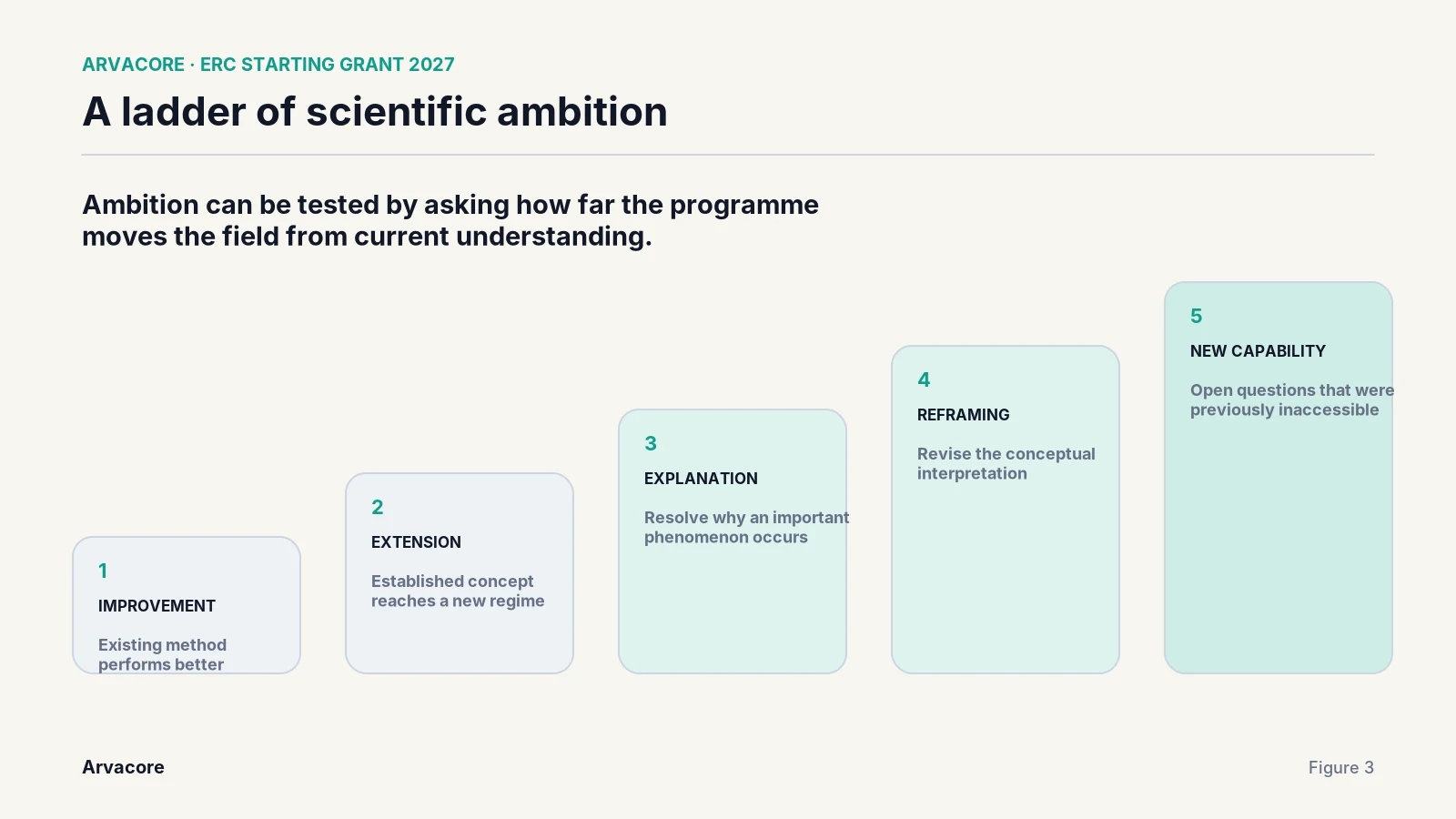
Scientific ambition can move from improvement and extension toward explanation, reframing and new scientific capability. The relevant level depends on the field, but the proposal should make the distance travelled explicit.
Ambition is not a specification sheet
Technical fields can make ambition look deceptively measurable.
A proposal may promise:
- ten times better resolution;
- a lower error rate;
- more samples;
- a wider frequency range;
- a faster algorithm;
- a larger device;
- another fabrication generation.
These may be valuable outcomes. They become scientifically ambitious when they are connected to an important unknown.
For example, improving sensitivity from one number to another is an engineering target. Asking which mechanism sets the apparent sensitivity limit, whether that limit is fundamental, and what regime becomes observable if it is removed creates a scientific programme.
The specification can support the question. It should not substitute for it.
A large vision can contain a focused project
There is no contradiction between thinking big and proposing a tractable programme.
The vision can be broad:
establish a new way of understanding collective behaviour in a class of systems.
The ERC programme can then identify the decisive subset:
determine whether mechanism X governs the transition under regime Y, establish the boundary conditions, and test whether the result generalises to Z.
This is often a better structure than trying to solve every aspect of the large problem in one proposal.
The large vision gives the project importance. The well-defined subset gives it scientific coherence.
Genuine uncertainty belongs in an ERC proposal
A proposal that can only produce the expected answer may be technically impressive, yet scientifically conservative.
For a Starting Grant at this level of public investment, I would expect the central scientific proposition to contain real uncertainty. The preferred hypothesis should be capable of being wrong.
That does not mean the proposal should be speculative in the sense of being disconnected from evidence or scientific reasoning. It means the programme should operate where the answer is not already known.
A useful question is:
What observation would force me to revise my preferred explanation?
If the proposal cannot answer this, the hypothesis may be descriptive rather than genuinely testable.
Scientific risk and project risk are different
High scientific ambition does not require careless execution.
Scientific risk concerns the answer:
- the mechanism may be different from the one proposed;
- an expected transition may not exist;
- a theoretical prediction may fail in the experimental regime;
- the accepted interpretation may remain more robust than expected.
Execution risk concerns whether the programme can generate interpretable evidence:
- equipment performance;
- fabrication yield;
- recruitment;
- access to data or samples;
- dependencies between work packages.
A strong ERC programme can carry substantial scientific uncertainty while managing execution uncertainty carefully.
The scientific question can remain bold because Part II gives the applicant space to show how the programme will be executed, monitored and adapted.
Design for scientific optionality
A preferred hypothesis can fail without making the research programme scientifically empty.
Suppose the project tests whether mechanism A explains phenomenon X.
Outcome 1: A is strongly supported. The project establishes the mechanism and can test its wider consequences.
Outcome 2: A operates only in a restricted regime. The project identifies boundary conditions and reveals where another mechanism becomes dominant.
Outcome 3: A is rejected. The evidence narrows the explanatory space, challenges an assumption and defines which alternative requires attention.
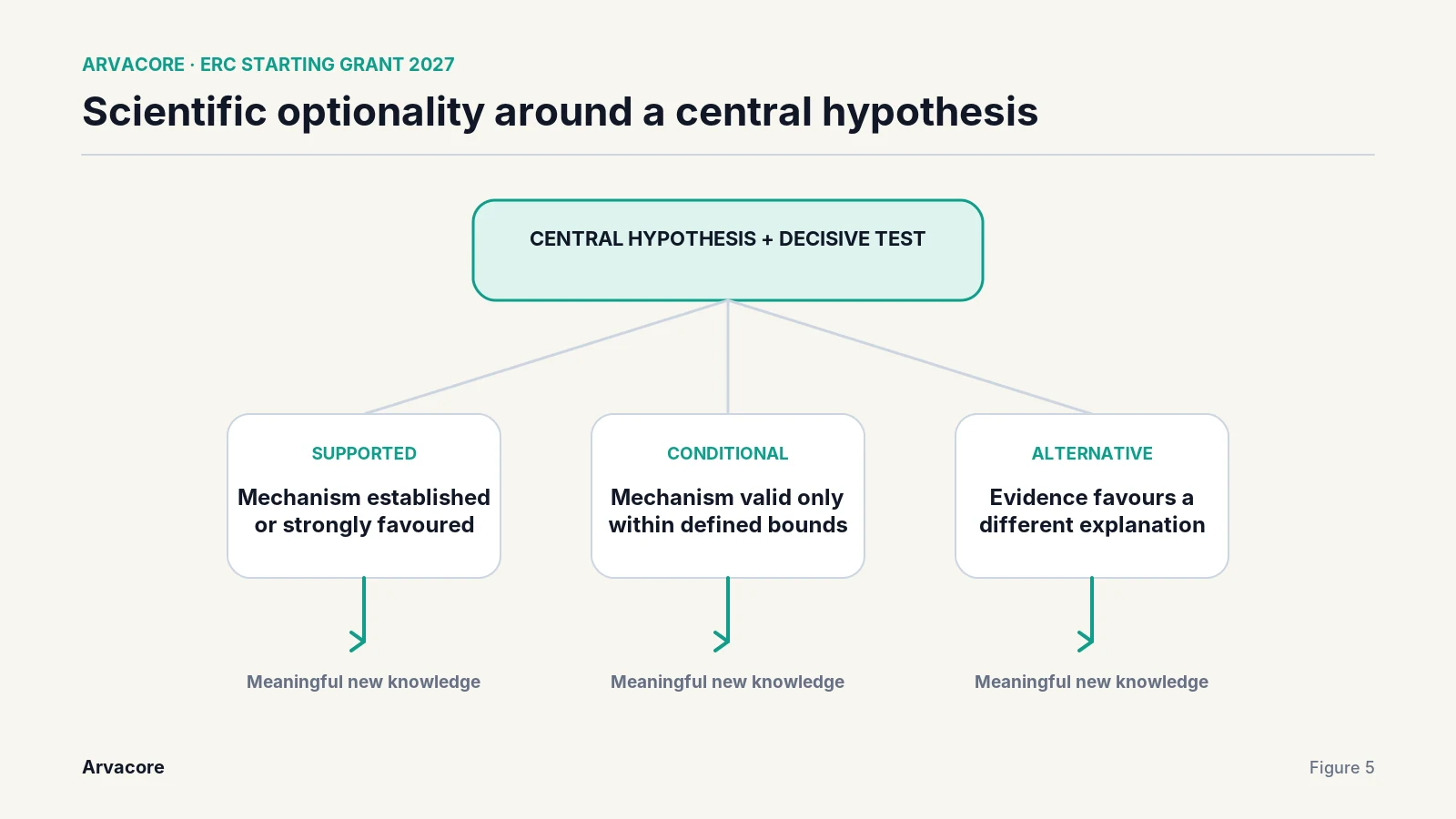
Scientific optionality means planning how different plausible results change the scientific interpretation. It is more useful than treating every unexpected result as a generic risk event.
The proposal should be committed to the question rather than emotionally committed to one answer.
Do not solve the project before asking for the grant
Preliminary evidence can establish plausibility. It can show that the relevant regime is accessible, that a surprising observation exists, or that the PI has the necessary technical capability.
The amount of evidence should be proportionate to the field and the claim.
My own preference is that the proposal leaves meaningful uncertainty alive. No preliminary evidence can be acceptable for some theoretical or conceptual questions. A small amount can strengthen plausibility. An extensive body of evidence can weaken the perceived need for a five-year frontier-research programme if it makes the main result look effectively known.
The proposal should create the feeling:
There is enough here to take the question seriously, and enough unknown to justify the programme.
Think in field-level consequences
A useful ambition test is to write the strongest plausible outcome without mentioning publications, conference papers or prototypes.
Complete one of these sentences:
- If successful, the field will be able to measure ________ for the first time.
- The current interpretation of ________ will need to be revised because ________.
- Researchers will gain access to a regime where ________ can finally be tested.
- A new class of experiments will become possible because ________.
- The programme will establish whether ________ is fundamental or contingent.
These statements express scientific payoff rather than project output.
Use public money with intellectual ambition
A standard Starting Grant can provide up to EUR 1.5 million over five years, with additional funding possible under the ERC rules. That is substantial public investment in one PI-led research programme.
The proposal should therefore make a credible case that the resources will buy more than incremental progress. The money should create the conditions to ask a question that would otherwise remain out of reach: building a team, establishing a new capability, accessing a difficult regime, integrating theory and experiment, or sustaining the programme long enough to resolve a deep uncertainty.
The aim is measured ambition: use the scale of the opportunity deliberately without exaggerating the claim.
A five-question ambition test
Before drafting Part I, I would answer:
- What is the largest scientific vision behind this project?
- Which subset can this five-year programme resolve rigorously?
- What answer would genuinely surprise specialists?
- What happens scientifically if the preferred hypothesis is wrong?
- What work could this programme create for the field after the grant ends?
If the answers are concrete, the ambition is becoming visible.
Be bold. Add figures. Think big.
That phrase is deliberately simple, but each part has a technical meaning.
Be bold: preserve real scientific uncertainty.
Add figures: use limited page space to compress a difficult concept when a visual can do it better than prose.
Think big: connect a focused programme to a field-level scientific consequence.
The proposal still needs discipline. The central question should be precise, the objectives should resolve specific uncertainties, and Part II should show how the programme can generate interpretable evidence. Ambition works best when the scientific logic is crisp enough for a reviewer to see exactly what is at stake.