
The central scientific question is the organising element of an ERC Starting Grant proposal. It connects the state of the art, the hypothesis, the objectives, the experiments or theory, the possible outcomes and the field-level consequence.
A useful question is neither a broad topic nor a task. It identifies an important unknown in a form that a research programme can address.
Start one level above the methods
Researchers naturally begin from what they know how to do:
- fabricate a new device;
- measure a new regime;
- develop an algorithm;
- collect a dataset;
- combine two methods;
- build a model.
These are capabilities. They become an ERC programme when they are organised around a scientific unknown.
For example:
Method-led framing:
Develop a new sensor with improved sensitivity.
Question-led framing:
Which physical mechanism sets the observed sensitivity limit in regime X, and can the limit be altered by controlling interaction Y?
The second statement creates a scientific decision. It can produce more than one meaningful answer.
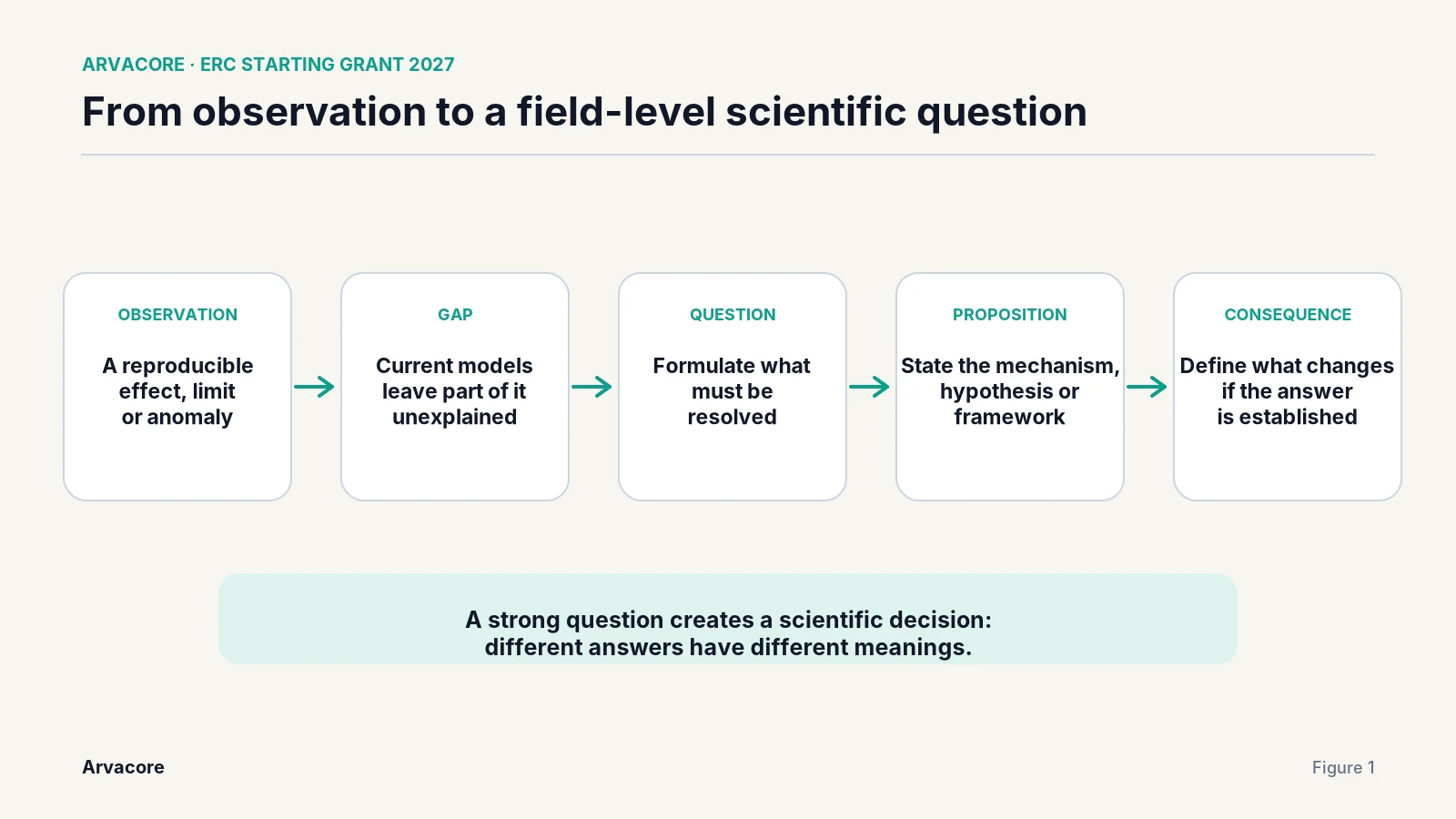
The strongest central questions emerge from a chain: current knowledge, unresolved limitation, scientific question, central proposition, research programme and field-level consequence.
Separate the topic, problem and question
These three levels are often mixed together.
Topic
A broad area of research.
Quantum sensing in solid-state systems.
Problem
A limitation or unresolved phenomenon within that area.
Sensitivity degrades unexpectedly in a regime where the standard noise model predicts continued improvement.
Scientific question
A precise unknown that can be resolved.
Does interaction X create the observed sensitivity floor, and under which conditions does it become the dominant mechanism?
The question gives the proposal direction. It tells the reader which uncertainty matters and which evidence could resolve it.
Define what the field currently believes
A good question needs a reference point.
Before writing the question, state the current understanding as clearly as possible:
The field currently explains phenomenon X through mechanism A.
Then identify the limit:
This model does not explain observation B in regime C.
Then the question:
Is mechanism D responsible for the deviation, and does it define a new regime of behaviour?
This structure makes novelty legible because the reader can see which assumption, gap or boundary the programme addresses.
Formulate a proposition that can be challenged
The question and the hypothesis are not identical.
The question defines the unknown.
The proposition or hypothesis offers an explanation that the programme will test.
For example:
Question:
What governs the transition between regimes A and B?
Hypothesis:
The transition is driven by collective mechanism C once parameter D crosses a critical threshold.
The hypothesis should create discriminating evidence. There should be observations that support it and observations that would force revision.
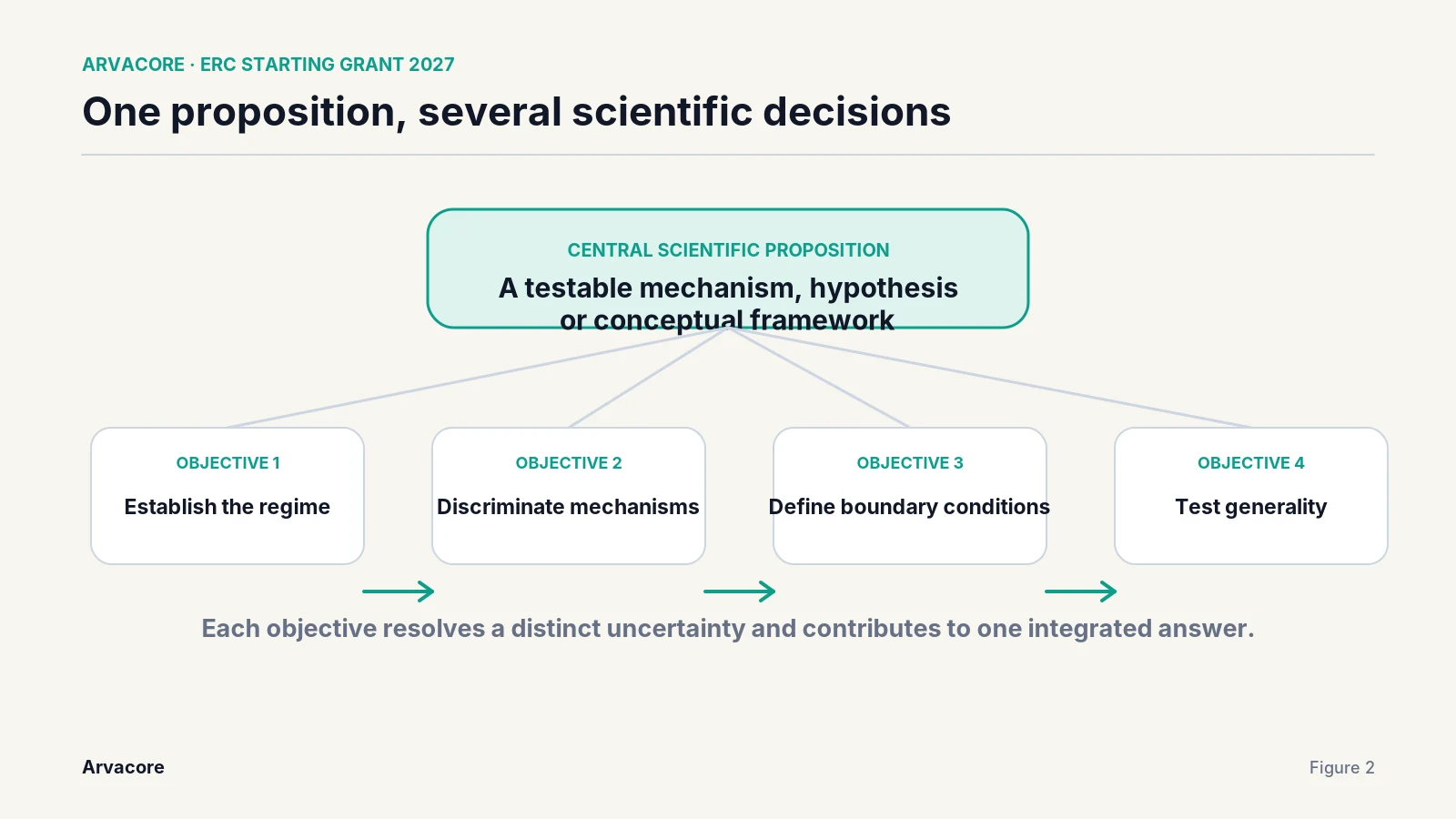
Objectives should resolve distinct parts of the central proposition. This creates one integrated answer rather than a collection of related tasks.
Ask what evidence would change your mind
This is one of the fastest ways to test whether a proposed question is scientifically useful.
Ask:
- Which observation would strongly support the proposition?
- Which observation would weaken it?
- Which alternative explanation would become more plausible?
- Can the programme distinguish between these possibilities?
A question becomes powerful when the possible answers have different scientific consequences.
If every plausible result leads to the same interpretation, the question may be too vague.
Keep the question large enough to matter
Precision does not mean shrinking the problem until the answer becomes routine.
A technically safe question can still be scientifically narrow:
Can method X improve parameter Y by 10%?
A broader scientific question may be:
What mechanism currently constrains Y, and is the accepted limit fundamental in the relevant regime?
The second question can still contain a precise experiment or model. Its payoff is larger because the answer changes understanding rather than only performance.
A useful test is:
If I answer this question convincingly, what does another researcher do differently afterwards?
Keep the question narrow enough to organise five years
The other failure mode is a question so broad that every interesting activity can fit underneath it.
Examples include:
How does the brain work?
Can quantum technologies transform sensing?
How can AI accelerate science?
These are visions or domains, not yet ERC research questions.
The proposal needs a central question with enough boundaries that objectives can be derived from it and completed within a coherent programme.
The relationship should be:
large vision -> defined unknown -> central question -> scientific proposition -> objectives -> evidence -> consequence
The large vision gives significance. The defined unknown gives focus.
Use one question to organise several objectives
An ERC project can contain multiple objectives while preserving one intellectual spine.
For example:
Central question:
Is phenomenon X controlled by mechanism A or B in the unexplored regime C?
Objective 1: establish the regime and measurable signatures.
Objective 2: identify evidence that discriminates A from B.
Objective 3: map the boundary conditions under controlled perturbation.
Objective 4: determine whether the mechanism generalises to a related system.
Each objective contributes to the same answer. This creates stronger coherence than four independent mini-projects.
Build the outcome space before the work plan
Before writing detailed methods, sketch the plausible scientific outcomes.
Suppose the preferred hypothesis is supported. What follows?
Suppose it holds only within a narrow regime. What follows?
Suppose it is rejected. Which competing interpretation becomes more likely?
This exercise does two things.
First, it reveals whether the question is genuinely informative.
Second, it creates scientific optionality. The programme remains valuable because different outcomes lead to different advances in knowledge.
Write the question in plain scientific language
A central question should survive removal of field-specific decorative language.
Try writing it for an adjacent expert who understands the discipline but not your exact niche.
A strong formulation usually contains:
- the phenomenon or mechanism;
- the unresolved relationship;
- the regime or boundary that matters;
- the scientific decision the project will make.
Avoid putting the entire methodology inside the question. Avoid turning the question into a paragraph. Avoid promising the answer in the wording.
Five tests for the central question
1. Importance
Would answering it matter to researchers beyond the immediate project?
2. Uncertainty
Is the answer genuinely unknown?
3. Discrimination
Can the programme distinguish between meaningful alternatives?
4. Ownership
Does the question establish a direction that belongs intellectually to the PI?
5. Consequence
Can you state how the strongest result changes understanding or capability?
A question that passes all five tests is a good candidate for the centre of Part I.
A one-page exercise before drafting B1
Write only the following:
Current understanding: three sentences.
Unresolved limitation: two sentences.
Central question: one sentence.
Central proposition: one sentence.
Three or four objectives: one sentence each.
Possible scientific outcomes: three bullets.
Field-level consequence: one sentence.
If this page is coherent, the proposal has a strong skeleton. If the logic remains difficult to explain at this level, more methodological detail is unlikely to solve the conceptual problem.
The question should create the need for the programme
The best central question makes the five-year programme feel necessary.
The reader can see why a small isolated experiment would not be enough, why a team is useful, why several lines of evidence are required, and why the answer could produce a larger scientific consequence.
That is a useful place to begin an ERC Starting Grant.